
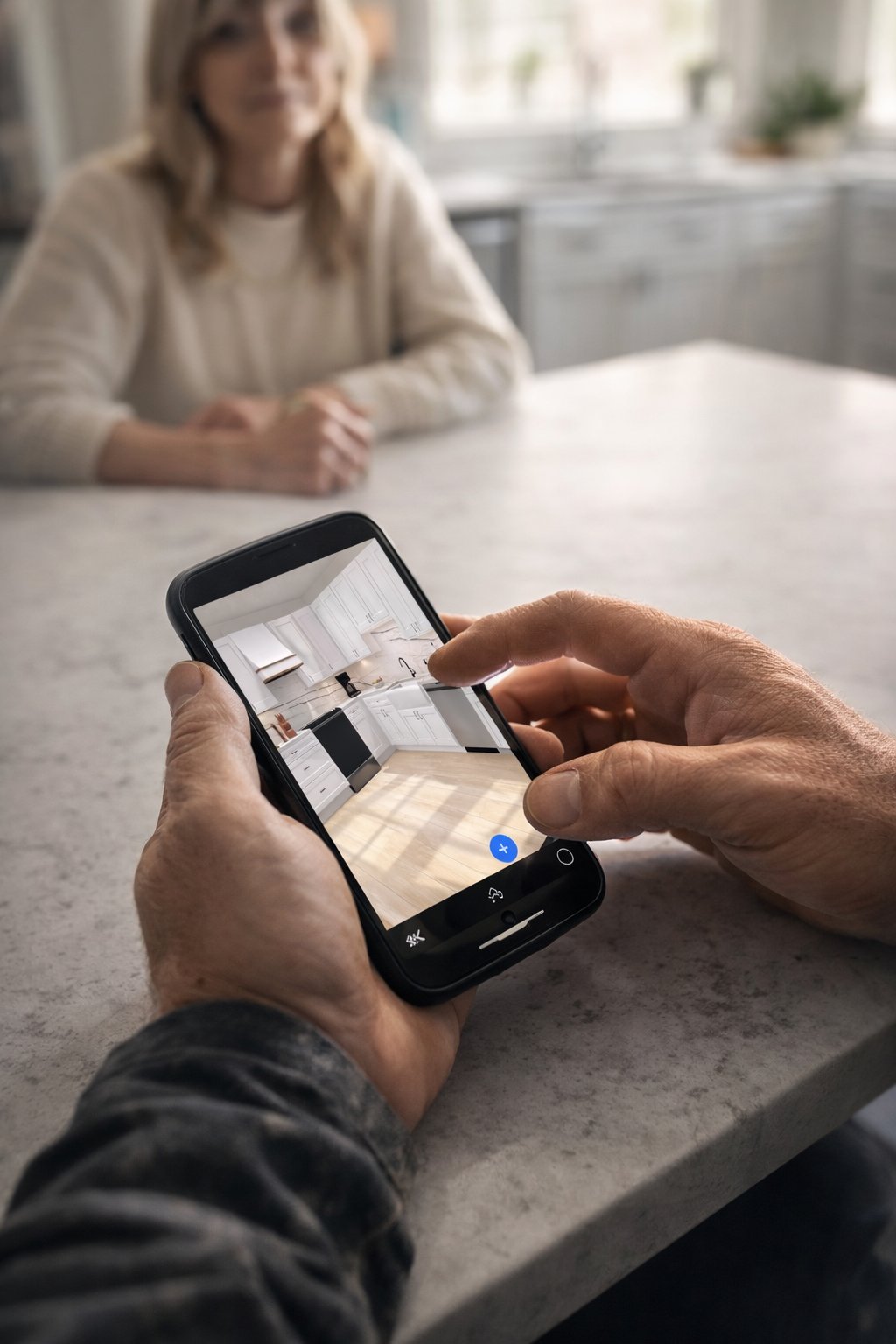
Why does the "cheaper guy" keep winning bids when your craftsmanship is clearly superior? It's a frustrating reality for many remodelers in 2026. You spend hours driving to sites and pulling tape measures, only to have clients ghost you because they simply cannot visualize the final kitchen layout. If you want to master how to increase closing rate for contractors, you must stop selling a promise and start showing a reality.
We know the frustration of losing hours to free estimates that lead nowhere. This guide promises to help you ditch the office-dependent workflow for a high-tech, on-site process that builds immediate trust and justifies your premium pricing. You will learn how to leverage mobile tools like ArchKit to capture LiDAR measurements and create AR visualizations in minutes. We are breaking down the exact steps to shorten your sales cycle, eliminate measurement errors, and close deals before the competition even gets their foot in the door.
Key Takeaways
- Stop relying on charisma and implement a repeatable, tech-driven sales process that builds trust through immediate results.
- Discover how to increase closing rate for contractors by ditching the "wait for the office" workflow that gives competitors time to swoop in.
- Bridge the visualization gap using AR tools to help clients see their future kitchen in real-time directly on the jobsite.
- Master the "one-visit close" by providing accurate estimates and professional layouts before leaving the client's home.
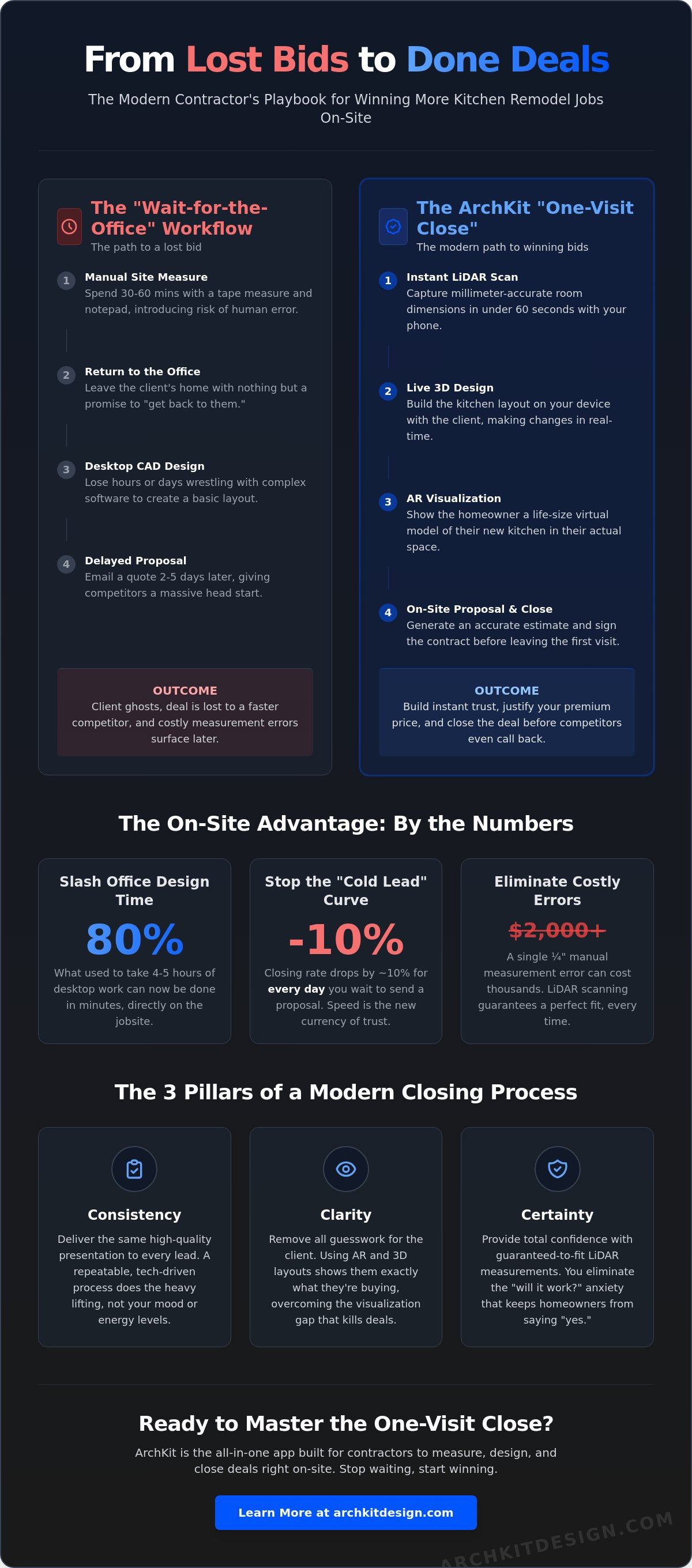
- Leverage LiDAR scanning to slash office design time by 80% and eliminate the manual measurement errors that lead to costly revisions.
The 'Natural Salesman' Myth: Why Process Trumps Personality
Many contractors believe they need the "gift of gab" to land high-ticket remodels. It's a tired myth. Charisma might get you through the door, but it rarely signs the contract. In the 2026 market, homeowners are wary of smooth talkers. They want experts with systems. Understanding that closing is a sales term focused on the final agreement is only half the battle. Real success comes from a repeatable, tech-driven workflow. If you are wondering how to increase closing rate for contractors, start by replacing your personality-led pitch with a process-led demonstration.
This shift creates the "Professionalism Paradox." Old-school methods like hand-drawn sketches or verbal promises now signal a lack of technical depth. To a modern client, a yellow notepad says "outdated." Conversely, using a contractor-focused kitchen design tool signals authority. You stop being a laborer who sells and become a consultant who solves. You aren't just guessing. You are measuring with LiDAR and visualizing with AR. This precision builds a level of trust that no amount of small talk can match.
The 3 Pillars of the Modern Closing Process
- Consistency: Deliver the same high-quality presentation to every lead. Don't rely on your mood or energy levels. Let the system do the heavy lifting.
- Clarity: Remove the guesswork. Use digital tools to show exactly where every cabinet sits. When clients see the layout, they stop worrying about the details.
- Certainty: Provide total confidence. Use LiDAR scanning to guarantee the fit. Eliminate the "will it work?" anxiety that keeps homeowners from saying yes.
Why 'Trust Me' is No Longer a Sales Strategy
Modern clients are data-driven. They live in a visual-first world. Asking a homeowner to "just trust you" is a recipe for a lost bid. They need to see the result before they pay for it. Digital transparency is the antidote to buyer's remorse. When you show a client a 3D AR model of their new kitchen on your first visit, you kill the hesitation that usually kills the deal. Build your authority through precision measurement. Use tools like ArchKit to generate instant layouts. Show them the data. Show them the design. Close the job on the spot.
Debunking the 'Wait for the Office' Proposal Workflow
The moment you walk out the front door, your chances of winning the job start to tank. Industry data suggests your closing rate drops by roughly 10% for every day you spend back at the office. This is the 'Cold Lead' Curve. While you are wrestling with desktop CAD software, your client is looking at photos of your competitor's work. To master how to increase closing rate for contractors, you must kill the delay. Speed is the new currency of trust.
Many pros still believe they need a high-powered workstation to generate an accurate quote. That's a 2010 mindset. In 2026, mobile processing power handles complex cabinet layouts in seconds. Waiting until 'next week' to send a proposal isn't being thorough; it's being slow. If you aren't providing a price and a plan on-site, you are giving the client permission to keep shopping. You are essentially telling them that your process is just as slow as the project will be.
Manual measurement errors are the silent killer of contractor margins. A simple 1/4 inch mistake on a field sketch can easily lead to $2,000 in wasted material and shop time. Digital tools eliminate this risk entirely. By implementing a repeatable system that increased sales for top firms, you replace messy 'scribbles' with verified data. You stop guessing and start knowing.
The Dangers of the Manual Sketch
Pulling out a yellow legal pad and a pencil makes you look like a hobbyist. Homeowners investing $50,000 or more in a kitchen want to see technical proficiency. Hand-drawn layouts create psychological friction. The client sees a scribble and wonders if their cabinets will actually fit. Misinterpreting these field notes later leads to re-work and lost profits. Digital precision removes the doubt and positions you as the expert who gets it right the first time.
Closing the Gap Between Visit and Vision
The 'Instant Draft' is your most powerful sales tool. Create the layout while the client is still in the room. Use on-site kitchen design tools to build a 3D model before you finish your coffee. The first contractor to show a visual model sets the benchmark for the entire project. Everyone else is just a name on a spreadsheet. If you want to stay ahead, get early access to modern mobile workflows and stop letting leads go cold while you sit at a desk.
The Visualization Gap: Why Clients Don’t Buy What They Can’t See
The Visualization Gap is the disconnect between your verbal description and the client's imagination. You describe a "shaker layout with a waterfall island." They hear your words but see a blank wall. This gap is the hidden reason contractors lose bids. If you want to master how to increase closing rate for contractors, you must realize that clients don't buy what they can't see. 2D floor plans are blueprints for builders, not sales tools for homeowners. They fail to excite because they require the client to do the mental heavy lifting. Stop asking your clients to work. Show them the result instead.
When a homeowner says "I need to think about it," they usually mean "I can't picture it." Decision fatigue sets in when a project feels abstract. Augmented Reality (AR) solves this by placing virtual cabinets directly into their physical room. It transforms an invisible concept into a tangible reality. You aren't just a contractor; you are a visionary showing them their future home. Use this tech to bridge the gap and eliminate the hesitation that kills high-ticket deals.
From Abstract to Concrete with 3D Rendering
3D models are the ultimate tool for reducing client anxiety. Seeing standard U.S. cabinet sizes in their actual space removes the fear of the unknown. Use 3D kitchen visualizers to upsell premium features like floor-to-ceiling pantries or custom islands. When the client sees the upgrade in high definition, the price tag becomes secondary to the value. It's much harder to say no to a beautiful 3D island than a line item on a spreadsheet.
AR Walkthroughs: The Ultimate Closing Tool
Let the client "walk" through their new kitchen before a single demo hammer swings. AR walkthroughs build an emotional connection that a static drawing never could. It feels real. This immersion makes your bid the benchmark for every other contractor they meet. If they can't see it with the other guy, they won't buy from the other guy. This process also protects your profit margins by catching layout issues visually during the first visit.
- Check fridge clearances in real-time.
- Verify walkway widths while standing in the room.
- Confirm cabinet heights against existing windows.
Doing this on-site establishes you as the expert who values precision over promises. You are providing certainty, and in 2026, certainty is what closes the deal.
Speed vs. Substance: How Instant On-Site Estimating Wins Bids
Responding to a lead in five minutes is useless if your proposal takes five days to build. While your competitors are busy "getting back to the office" to crunch numbers, you should be finalizing the deal. In 2026, the only combination that wins is speed plus substance. If you want to master how to increase closing rate for contractors, you must provide a professional, data-backed estimate before you walk out the front door. This isn't just about being fast. It's about being the most prepared person in the room.
The "One-Visit Close" is no longer a myth for high-end kitchen remodels. It's a reality powered by mobile processing. By generating a cabinet list and a rough estimate on-site, you capitalize on peak client interest. Their excitement is highest while you are standing in their kitchen. Don't let that energy dissipate. Provide the clarity they need to make a decision immediately. When you combine LiDAR accuracy with instant pricing, you eliminate the friction that usually leads to "we'll think about it."
LiDAR: The Contractor’s Secret Weapon
Ditch the tape measure. It's slow and prone to human error. Modern LiDAR kitchen scanners capture million-dollar accuracy in seconds using the sensors already in your phone. These tools map room geometry, windows, and plumbing locations with zero manual entry. This digital record is your best defense against scope creep. If a wall is out of plumb or a pipe is off-center, you know it instantly. You aren't just selling a kitchen; you are selling a project that you've already verified will fit. This precision builds a level of authority that a laser level and a notepad simply cannot match.
Step-by-Step On-Site Closing Workflow
To win more bids, follow a structured, tech-driven sequence. This workflow turns a standard consultation into a high-conversion sales event. Stop guessing and start demonstrating.
- Step 1: Scan the room. Use a LiDAR-enabled app to create a perfect digital twin of the space in under two minutes.
- Step 2: Drop in cabinets. Select standard sizes from a digital catalog to build an instant 3D layout.
- Step 3: Review the model. Turn the screen toward the client. Get immediate feedback on the island placement or the sink location.
- Step 4: Generate the estimate. Use the digital cabinet list to provide a rough cost. Secure the commitment while the vision is fresh.
Mastering this workflow is the fastest way to justify premium pricing. You aren't just another contractor; you are a tech-forward professional. Get early access to the ArchKit workflow and start closing deals before your competition even finishes their drive home.
Turning Measurements into Contracts: The ArchKit Closing Workflow
Closing isn't just about the final handshake. It's about the technical workflow that leads you there. Integrating ArchKit into your daily routine transforms a stressful estimate into a seamless, professional demonstration. The "Scan-to-Design" advantage is a game changer for busy remodelers. You can reduce office design time by 80% by handling the layout and cabinetry selection while you are still on the job site. Leveraging the best kitchen design apps makes you look like a tech-forward firm that values precision over guesswork. This is exactly how to increase closing rate for contractors who are tired of being treated like a commodity.
Cloud-based project sharing simplifies the approval process. You no longer need to wait for a client to open a massive PDF attachment days later. Share the interactive 3D model immediately. They can review it on their own device, making the decision-making process faster and more collaborative. This transparency builds a level of trust that "old school" contractors simply cannot match. You aren't just selling a kitchen; you are providing a modernized service experience from the very first minute.
ArchKit: Built for the Job Site, Not the Office
Ditch the stationary office equipment. ArchKit is a mobile-first CAD tool designed specifically for the iPad and iPhone. Unlike legacy desktop software that requires hours of training, this tool is built for the fast-paced reality of the field. You get full access to standard U.S. cabinetry catalogs right on your device. This allows you to drop in real-world dimensions and see the fit instantly. This LiDAR-driven accuracy is the foundation of a 30%+ closing rate because it removes the "what if" from the sales conversation. You know it fits, and now the client knows it too.
Winning the Bid Before You Leave the Driveway
The "Wow Factor" is your greatest competitive asset. When you leave the driveway, your client should already be showing your 3D model to their friends and family. That emotional connection is what prevents them from price-shopping your bid. If they have pricing objections, use the visual data you just captured to justify the cost. Show them exactly how the cabinet layout maximizes their footprint or why a specific island size is necessary for their plumbing locations. Visual evidence kills objections. Check out ArchKit pricing to start closing more deals and reclaiming your office time today.
Master the On-Site Close
The days of "getting back to you next week" are over. In 2026, homeowners demand transparency and speed. You've seen how a repeatable, tech-driven system beats individual charisma every time. By closing the visualization gap with AR and eliminating manual errors with LiDAR, you justify premium pricing on the spot. This is how to increase closing rate for contractors who want to stop losing to the "cheaper guy." To apply this same efficiency to your exterior projects, check out 1ESX Roof & Wall Reports for automated, professional measurement data.
Mastering the on-site close means moving from verbal promises to visual reality. Use LiDAR accuracy to ensure every measurement is perfect. Leverage the standard U.S. cabinet catalog to build layouts in minutes. Show the client their future kitchen through AR visualization before you leave the driveway. You aren't just selling a remodel; you are selling confidence. Don't let another lead go cold while you sit at a desk. Take control of your workflow and your profits today.
Start Winning More Bids—Get ArchKit Early Access Now.
The future of your business is built in the field. It's time to own the jobsite.
Frequently Asked Questions
How much does a good closing rate for contractors actually matter?
Your closing rate is the single most important metric for business profitability. A higher rate means you spend less money on marketing and fewer hours driving to unsuccessful site visits. Mastering how to increase closing rate for contractors allows you to be more selective with your projects. You stop chasing every lead and start focusing on high-margin work that fits your schedule.
Can I really increase my closing rate without lowering my prices?
Yes, you increase your rate by providing more value and certainty than the competition. Homeowners often choose higher-priced contractors who prove they understand the project details through visual models and precise data. Professionalism justifies a premium. When you show a client their kitchen in AR during the first visit, you aren't just a laborer. You are a consultant providing a superior experience.
Is LiDAR scanning accurate enough for kitchen cabinet layouts?
LiDAR scanning provides the high-level accuracy required for initial layout planning and estimating. It captures room geometry, plumbing locations, and window placements instantly. While you should still perform final tight measurements before ordering custom cabinets, LiDAR eliminates the major layout errors that cause project delays. It is a high-speed tool for securing the contract and setting the design foundation.
How does 3D visualization help with difficult clients?
3D visualization removes the ambiguity that causes difficult clients to hesitate. Most difficult behavior stems from anxiety about the final result. Showing them exactly where the cabinets will sit and how the island will function kills that uncertainty. It turns a verbal argument into a visual collaboration. You stop defending your ideas and start letting the model prove the project's logic.
What is the best way to follow up on a kitchen remodel lead?
The best follow-up is an immediate digital share of the on-site design. Don't send a generic email. Send a link to the 3D model you created during the visit. This keeps the project fresh in their mind and gives them something to show family and friends. Speed is critical. If you leave the site without providing a visual benchmark, you lose the momentum of the initial meeting.
Do I need an iPad Pro to use LiDAR scanning for kitchen design?
You need a device with a built-in LiDAR sensor, which includes iPad Pro models from 2020 onward or iPhone Pro models starting with the iPhone 12 Pro. These devices allow apps like ArchKit to map the room in 3D. If you don't have a Pro device, you can still use the layout tools manually. However, the LiDAR sensor is the key to the scan-to-design speed that wins bids.
How can I reduce the time I spend on free estimates?
Stop doing manual takeoffs at the office. Use mobile tools to generate your layout and material list while you are still standing in the client's kitchen. Moving the design work to the first site visit eliminates the office backlog that eats up your evenings. If a lead isn't willing to engage with the on-site design process, they likely aren't a serious buyer ready to move forward.
What are the most common mistakes contractors make during a sales call?
The biggest mistake is leaving the site without a visual commitment or a clear next step. Many contractors rely too much on verbal promises and getting back to the office. This creates a delay where the client starts second-guessing the project or looking at other bids. Another mistake is failing to address the visualization gap. If the client can't see the result, they won't sign the contract.


