
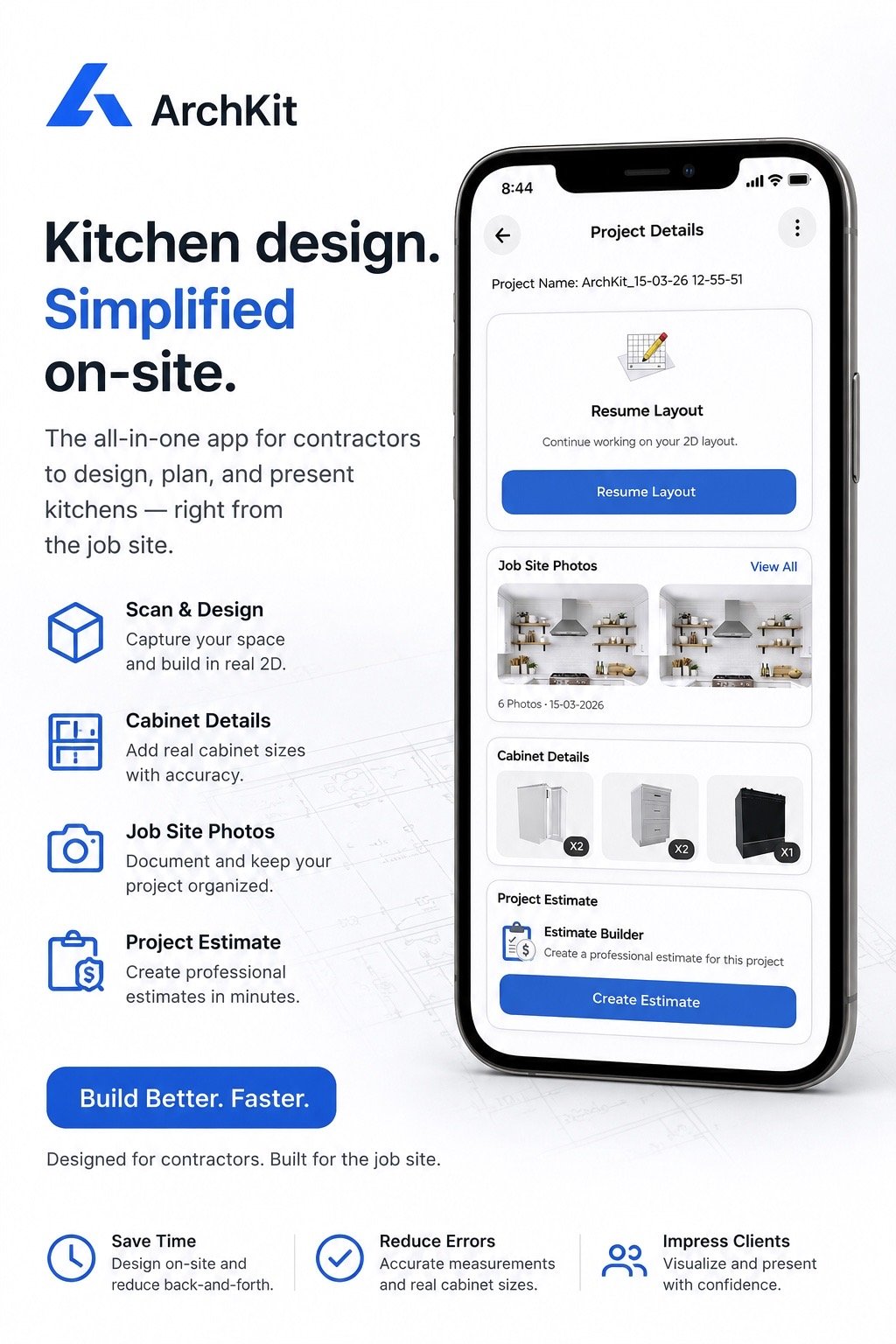
Construction input prices jumped 9.6% this past year while diesel costs skyrocketed by 105.9%. These numbers make improving kitchen remodel profit margins feel like a constant battle against your own balance sheet. You are likely feeling the squeeze between rising material costs and the pressure to keep your bids competitive. It is a frustrating reality. One mismeasured cabinet or a week of back and forth design revisions can evaporate your entire net profit. You didn't get into this trade to spend your life behind a desk fixing manual errors.
We agree that spending your nights drafting layouts instead of on-site selling is a recipe for burnout. It is time to stop the bleed. This guide will show you how to plug labor leaks and maximize every dollar in your projects using modern on-site design workflows. We will explore how tools like ArchKit use LiDAR and AR to eliminate measurement errors and slash revision cycles. Learn how to secure faster client approvals and boost your net profit before you even leave the job site.
Key Takeaways
- Stop confusing gross margins with net profit. Learn why elite remodelers hit 15-20% targets by tightening their internal business operations.
- Identify the "Office Trap" that drains your productivity. Reclaim 4-6 hours per project by moving your design work from the desk to the job site.
- Master the art of improving kitchen remodel profit margins by eliminating the $2,000 mistakes caused by manual measurement errors.
- Use LiDAR scanning and AR visualization to lock in client approvals instantly. Prevent costly revisions by letting homeowners walk through their new space before demo begins.
- Adopt the ArchKit workflow to build accurate 3D models and professional estimates on-site. Professionalize your presentation to justify higher markups and win more bids.
Defining Kitchen Remodel Profit Margins in 2026
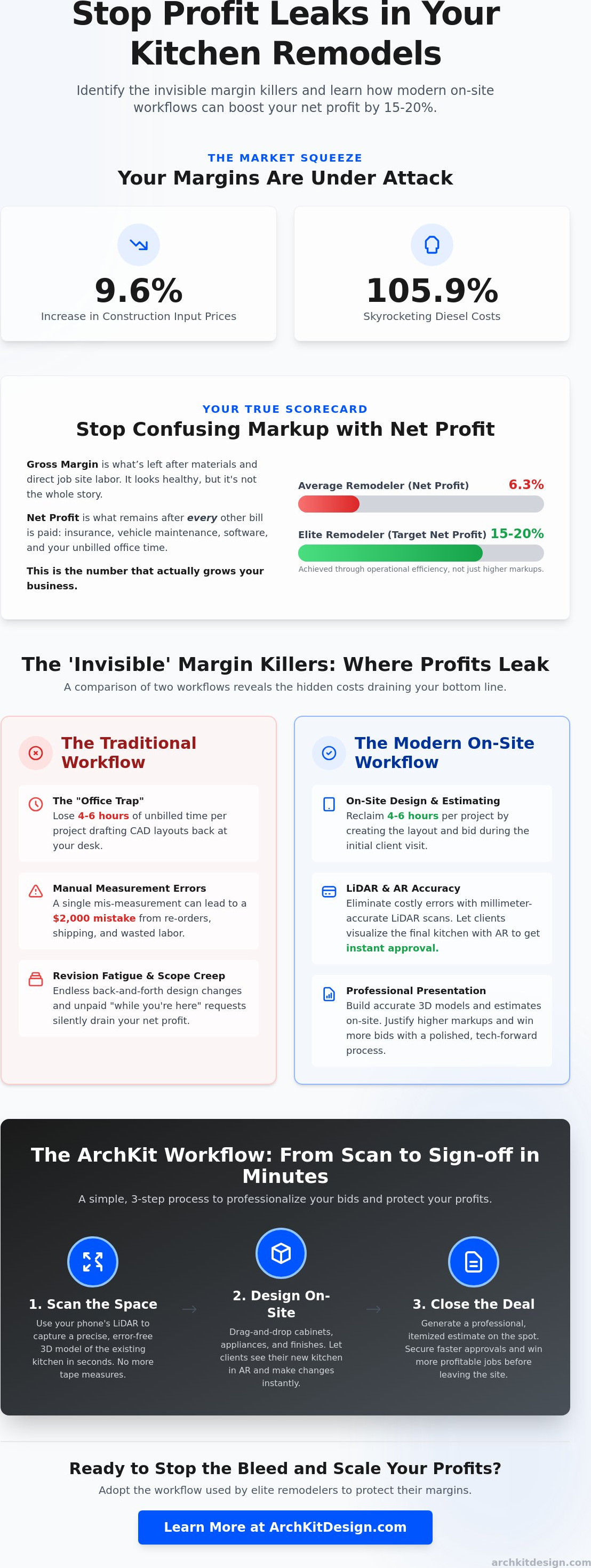
Stop confusing markup with margin. It is the fastest way to go broke while staying busy. In the process of improving a client's home, many contractors apply a standard markup and assume they are safe. They aren't. While the average gross profit margin for remodelers reached 29.9% in 2024, the net profit is what actually keeps your doors open. Elite kitchen remodelers in 2026 aren't settling for the national average of 6.3% net profit. They are targeting 15-20% by obsessing over operational efficiency. Improving kitchen remodel profit margins starts with realizing that markup is just a math tool, but margin is your actual business grade.
Inflation has changed the rules. Construction input prices rose 9.6% year-over-year by May 2026. Iron and steel are up 7.0%. If you are still using 2024 pricing models, you are losing money before the first cabinet arrives. Static markups cannot keep up with volatile material costs. You must shift your focus from "how much can I charge" to "how much can I keep."
Gross vs. Net: The Contractor's Scorecard
Your gross margin is what's left after paying for materials and direct job site labor. Your net profit is what remains after every other bill is paid. Most contractors fail because they ignore "soft" overhead. Calculate your true costs. This includes vehicle maintenance, insurance premiums, and your software subscriptions. If your spreadsheet doesn't account for the time you spend driving to pick up a forgotten trim piece, your net profit is a lie. Slippage is the silent killer here. It's the gap between your estimate and reality. In 2026, even a 2% slippage rate can wipe out your entire bonus for the quarter.
2026 Market Realities for Kitchen Pros
Labor scarcity is no longer a temporary problem; it is a permanent fixture of the trade. You cannot simply "hire your way" out of a backlog anymore. You have to work smarter. Every hour your lead carpenter spends waiting for a design clarification is pure "dead time" that burns your margin. The same applies to the "Office Trap." Spending six hours drafting a CAD layout for a bid you might not win is an expensive gamble. High-efficiency contractors use mobile tools to close this gap. Margin creep in 2026 is the gradual erosion of project profitability caused by unbilled administrative tasks, rising fuel costs, and minor measurement discrepancies that compound over the life of a kitchen remodel.
The 'Invisible' Margin Killers: Where Profits Leak
Stop the bleed. Most contractors focus on material markups while ignoring the hours lost to administrative friction. If you aren't tracking your time spent on-site versus time spent in the office, you are likely losing money. The "Office Trap" is a primary culprit. You spend 4-6 hours drafting CAD layouts after the initial site visit. This is unbilled labor. It is a massive cost center that never appears on your invoice. Improving kitchen remodel profit margins requires identifying these leaks before they sink the project.
Measurement errors are another silent killer. A mismeasured corner cabinet isn't just a minor headache; it's a $2,000 hit to your bottom line. You pay for the re-order, the expedited shipping, and the wasted labor hours for a crew standing around an empty wall. Revision fatigue compounds this problem. Three rounds of "simple changes" to a cabinet layout can eat your entire net profit. If you aren't closing the gap between the measurement and the final design, you are gambling with your margins.
The True Cost of Manual Measurements
Tape measures are slow and prone to human error. Every time you pull a tape, you risk a 1/8-inch discrepancy that ruins a tight cabinet run. Return trips to "double-check" a single dimension are a drain on fuel and productivity. Transcription errors are even worse. Moving handwritten notes from a greasy notepad into desktop software is where most mistakes happen. Digital tools eliminate this manual data entry. They capture the space once and keep the data clean. To stop the office trap today, you can get early access to mobile design workflows that handle the heavy lifting while you are still on the job site.
Scope Creep and the 'While You're Here' Syndrome
Vague estimates lead to unpaid extras. Without a visual 3D proof at the bid stage, clients often misunderstand the scope of work. They assume the "while you're here" requests are included in the price. These small, un-documented change orders are financial paper cuts. They eventually bleed your project dry. Using digital layouts creates a hard boundary. It shows the client exactly what they are paying for. When the homeowner sees a precise 3D model, it sets expectations and makes it much harder for scope creep to settle in. Professionalize your boundaries to protect your profit.
Communication gaps cause delays. If your crew doesn't have a clear, visual layout on their phones, they make assumptions. Assumptions lead to rework. Rework is the ultimate margin killer in 2026. Keep your data digital, keep your layouts visual, and keep your profit in your pocket.
Accelerating the Design-to-Bid Cycle for Maximum ROI
Speed is your most powerful competitive edge. In the current market, the "Speed to Lead" rule is absolute: the first contractor to present a professional visual bid wins the contract 70% of the time. If you are still driving back to the office to "crunch the numbers," you are leaving money on the table. Improving kitchen remodel profit margins requires you to condense the design-to-bid cycle into a single, high-impact on-site visit. Closing the deal before you leave the driveway isn't just a goal; it's a necessity for 2026 efficiency.
The math is simple. Every hour spent in the office drafting is an hour you aren't selling or managing a crew. Legacy desktop CAD software forces a fragmented workflow that kills momentum. You measure, you drive, you draft, and you wait. This delay allows the client to second-guess the project or talk to a faster competitor. Modern mobile workflows flip this script. By moving the design phase to the job site, you maintain the emotional connection with the homeowner and secure their commitment while their excitement is at its peak.
Traditional vs. Modern Workflow Comparison
Compare the two paths. The traditional workflow involves a tape measure, a notepad, and a desktop computer. This process often takes 48 to 72 hours from the first visit to the first bid. It is slow, prone to transcription errors, and disconnects the design from the actual space. A modern workflow uses digital tools to bridge this gap instantly. Using ArchKit for LiDAR room mapping allows you to capture every dimension with 1/8-inch accuracy in seconds. This technology cuts your design time by 80%. You can scan the room, drop in a cabinet layout, and present a 3D visualization to the client before you even finish your coffee. This immediate visual proof builds massive trust and eliminates the "I'll think about it" phase.
Standardization as a Profit Strategy
Custom-everything is a margin trap for small-to-mid-sized firms. While bespoke projects sound prestigious, they are often a nightmare for project timelines and labor costs. To protect your profit, standardize your catalog. Leverage U.S. standard cabinet sizes to automate your pricing and layout logic. When you work within a defined set of specifications, estimating becomes a "menu-based" exercise rather than a complex math problem. This approach prevents decision paralysis in clients. Present them with a curated selection of high-value options instead of an infinite list of possibilities. You simplify their experience, reduce your drafting time, and ensure your labor costs remain predictable. Standardization is not about limiting creativity; it is about securing your net profit.
Reducing Costly Revisions with AR and LiDAR Technology
Revisions are the final boss of margin erosion. Even with a signed contract, every "minor tweak" requested mid-project drags your crew back and eats your labor budget. Improving kitchen remodel profit margins depends on your ability to lock in a final design that actually fits the space. If you are still relying on a tape measure and a hope that the walls are square, you are inviting disaster. LiDAR and Augmented Reality (AR) aren't just toys; they're your primary defense against the 20% restocking fees and wasted days that kill your net profit.
Stop guessing. Start scanning. LiDAR technology captures 1/8-inch accuracy in seconds. It builds a digital twin of the kitchen that accounts for wonky walls and out-of-plumb corners. When you combine this precision with instant 2D and 3D layouts, you eliminate the "I didn't realize it would look like that" objection before it ever happens. You provide a single source of truth for your installers, ensuring that the cabinets you order are the cabinets they can actually hang. To start protecting your projects from these errors, get early access to our mobile workflow today.
Eliminating Measurement Risk
Manual measurements fail because they assume a room is a perfect box. It never is. LiDAR identifies the non-square walls that a tape measure misses, preventing the nightmare of a custom pantry cabinet that won't fit into a tapered alcove. By integrating this data directly into modern cabinetry layout tools, you ensure your design is technically sound from the start. The ROI is immediate. Avoiding just one return trip to fix a misordered filler piece pays for your entire digital toolkit for the year. Precision is profit.
AR as a Closing Tool
Clients struggle to read 2D blueprints. This "comprehension gap" is where most change orders are born. Using 3D kitchen visualizers with AR capability allows homeowners to "walk" through their new space before you swing a single demo hammer. They can check island clearances and reach for virtual upper cabinets in real-time. AR walkthroughs minimize change order friction by aligning client expectations with the physical reality of the design before construction begins. When a client sees the layout overlaid in their actual home, the approval gap disappears. They stop questioning the price and start picturing the result. You win the bid, you keep the margin, and you move to the next job faster.
Scaling Profits: The ArchKit Workflow for Contractors
Scaling your business doesn't mean working more hours. It means making every hour you work more valuable. Improving kitchen remodel profit margins is impossible if you are stuck in a cycle of manual drafting and constant site revisits. You need a system that moves as fast as you do. By adopting a mobile-first workflow, you reclaim the 4-6 hours per project typically lost to the "Office Trap." This efficiency allows you to take on 20% more projects per year without adding a single person to your payroll. It is about working smarter; not harder.
Professionalism is your best defense against price shoppers. When you arrive on-site with modern technology, you immediately differentiate yourself from the "clipboard and tape measure" crowd. Clients perceive a higher value in your services because your process is transparent and visual. This perceived value allows you to justify higher markups while maintaining a high closing rate. You aren't just a contractor; you are a tech-forward professional who respects the client's time and money. To see how specialized Virtual Design and Construction studios can support your larger design and construction goals, read more.
From Lead to Contract in One Visit
The goal is simple: don't leave the kitchen without a commitment. The ArchKit workflow makes this possible through a streamlined four-step process. First, scan the room using LiDAR to capture every dimension. Second, drop in cabinetry and appliances using standard catalogs. Third, show the client the 3D model in their actual space via AR. Finally, generate and send the bid before you walk out the door. This speed is why clients pay a premium for contractors who use modern kitchen design apps for iPhone. You eliminate the "waiting period" where interest cools and competitors can swoop in. Integrating this tool into your existing project management stack ensures that your data stays clean from the first scan to the final inspection.
Investing in Your Bottom Line
Every tool in your truck has a cost; your software should be no different. When you analyze ArchKit pricing, compare it to the cost of a single misordered cabinet or a crew standing around on a Tuesday afternoon. One avoided error pays for the technology for an entire year. Onboarding your team is just as efficient. Because the tool is built for the field, most professionals can master the mobile-first design workflow in under an hour. You don't need a degree in CAD to build a profitable business. You just need the right tool in your pocket. Ready to stop leaking profit? Get early access to ArchKit now and start improving kitchen remodel profit margins on your very next project.
Take Control of Your 2026 Profitability
Improving kitchen remodel profit margins requires a permanent shift from office-bound drafting to immediate on-site action. We have explored how the "Office Trap" and manual measurement errors act as invisible leaks that drain your net profit. By moving your design phase to the job site, you eliminate the friction that causes scope creep and client hesitation. You stop the bleed of unbilled hours and start closing contracts faster.
ArchKit empowers you with LiDAR-powered 3D scanning and a standard U.S. cabinet catalog to build accurate bids in minutes. You can provide instant AR walkthroughs that lock in client trust before you even leave the kitchen. This technology is your best defense against rising material costs and labor scarcity. Stop wasting time behind a desk and start winning more bids in the field.
Streamline your workflow and protect your margins with ArchKit.
Your expertise deserves a workflow that matches your pace and maximizes your earnings. You have the skills to build great kitchens; now you have the tools to build a more profitable business.
Frequently Asked Questions
What is a good profit margin for a kitchen remodel in 2026?
Targeting a net profit margin of 15% to 20% is the current benchmark for high-performing contractors. While the national average for remodelers was 6.3% in 2024, elite professionals focus on improving kitchen remodel profit margins by reducing unbilled office hours. You must account for the 9.6% increase in construction input prices seen in May 2026 to ensure your margins stay healthy throughout the project lifecycle.
How can I reduce measurement errors in my kitchen projects?
Replace manual tape measures with LiDAR-enabled scanning tools to capture room dimensions with 1/8-inch accuracy. Digital scanning identifies non-square walls and out-of-plumb corners that human eyes often miss. This technology creates a single source of truth for your cabinet orders. You eliminate the risk of transcription errors that happen when moving handwritten notes from a job site pad into office software.
Does using a kitchen design app actually save money?
Yes, a kitchen design app saves money by reclaiming 4 to 6 hours of unbilled drafting time per project. Tools like ArchKit allow you to design on-site, which means you don't spend your evenings behind a desk. You also avoid the expensive restocking fees associated with misordered cabinets. By closing leads in one visit, you reduce your administrative costs and increase your overall project ROI.
What is the biggest hidden cost in kitchen remodeling?
The biggest hidden cost is design labor friction, which includes the unbilled hours spent on drafting, revisions, and return trips for measurements. These administrative tasks can burn through your net profit before you even start the demolition. Another major leak is scope creep caused by vague estimates. Without a visual 3D proof, clients often assume extra work is included in the initial price.
How do I explain my markup to a skeptical client?
Shift the conversation from material costs to the value of project management and expertise. Explain that your markup covers the 17.3% increase in truck freight transportation and the specialized labor required for a modern kitchen. Use professional 3D visualizations to show the client exactly what they are paying for. When homeowners see a precise digital plan, they understand they are paying for a guaranteed result.
Can LiDAR technology replace a manual tape measure for cabinets?
LiDAR technology is now the primary tool for capturing base dimensions, though a tape measure remains useful for verifying specific filler widths. A LiDAR-equipped device scans an entire room in seconds, capturing details that manual measurements miss. It provides the high-performance data needed for cabinetry layout tools. You get a digital twin of the space that ensures your layout is technically sound from the start.
How much time should a contractor spend on a kitchen estimate?
You should aim to deliver a professional estimate in under 60 minutes while still on-site. The Speed to Lead rule shows that the first contractor with a visual bid wins the contract 70% of the time. Improving kitchen remodel profit margins requires you to use mobile software to scan the room and drop in a cabinet layout instantly. This condensed cycle prevents client second-guessing and keeps your administrative overhead low.
What are the benefits of using AR for kitchen design presentations?
Augmented Reality lets clients walk through their new kitchen before construction begins, which builds immediate trust. It reduces change order friction by aligning client expectations with the physical reality of the space. Homeowners can reach for virtual cabinets and check island clearances in real-time. This immersive experience professionalizes your presentation and makes it much easier to justify your bid over a competitor's 2D blueprint.


