
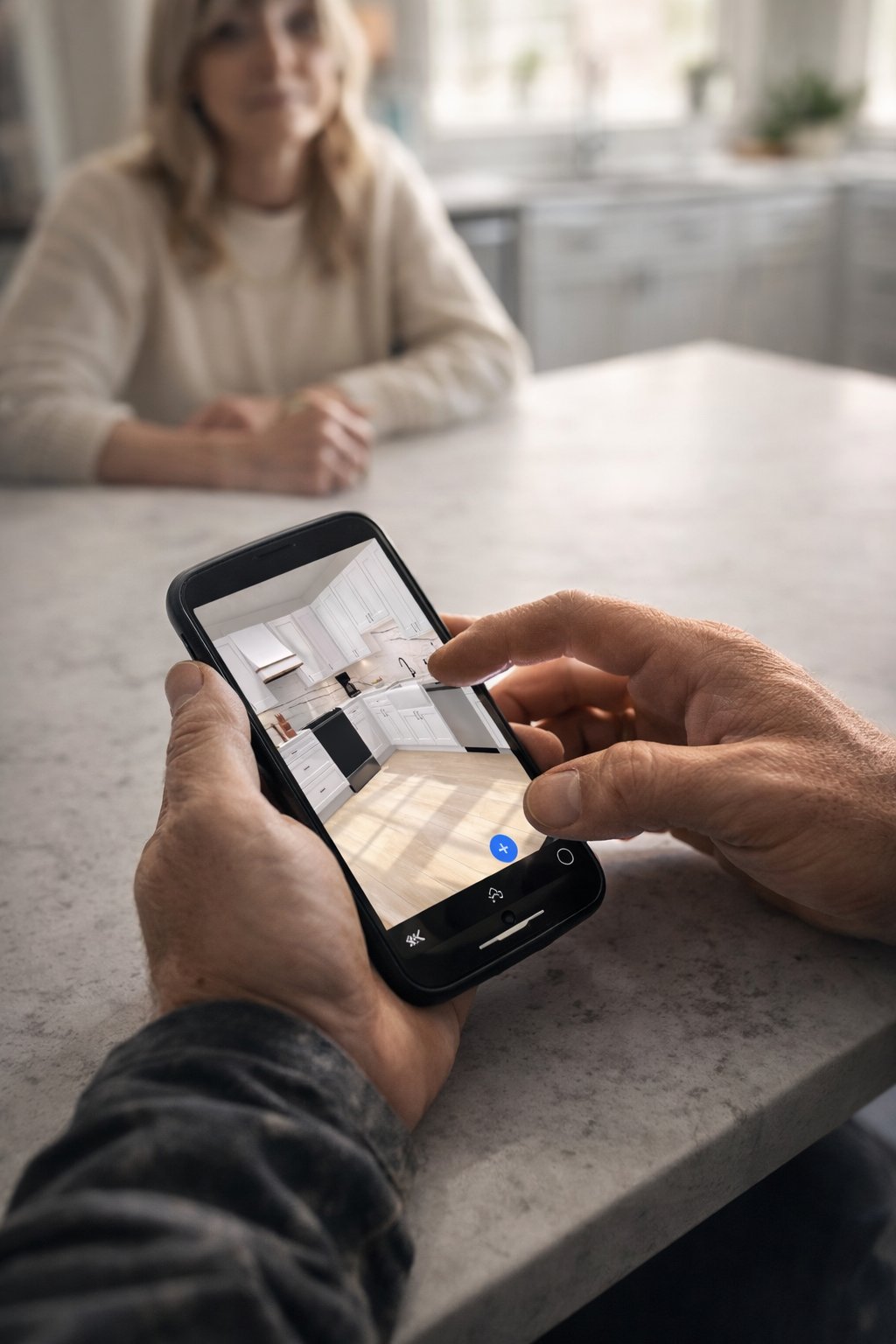
Your client thinks their $35,000 budget covers a luxury custom overhaul. It doesn't. In 2026, a mid-range kitchen remodel averages $35,000. That 30% gap between their dream and the data is where your profit goes to die. You've seen it before. The "Pinterest effect" creates expectations that your crew can't meet without blowing the budget or facing endless revisions. Managing client expectations kitchen remodel is no longer about talking more. It's about showing the truth on day one.
Stop the friction caused by office-bound design delays and manual measurement errors. This guide shows you how to master client communication and eliminate the reality gap using modern on-site workflows. You'll learn to secure faster project approvals and higher referral rates by bringing the design process directly to the job site. We will explore how tools like ArchKit use LiDAR scanning and AR visualization to turn vague ideas into signed contracts while you're still standing in their kitchen.
Key Takeaways
- Bridge the "Reality Gap" by aligning DIY-inspired expectations with actual job site physics and modern 2026 sustainability standards.
- Implement a "No-Surprise" budget policy using detailed digital estimates to set hard boundaries on custom lead times and costs.
- Master managing client expectations kitchen remodel by using AR visualization to let clients experience their new layout before any walls are moved.
- Eliminate "I’ll go back to the office" delays by developing an on-site workflow for handling project pivots and revisions in real-time.
- Leverage a LiDAR-to-3D pipeline like ArchKit to build instant authority and secure faster project approvals directly from the field.
The 2026 Remodel Reality Gap: Why Client Expectations Are Shifting
The "Remodel Reality Gap" is widening. It is the growing distance between the polished DIY transformations seen on social media and the actual physics of a professional job site. Today’s homeowners enter meetings with high-definition dreams but little understanding of logistical hurdles. In 2026, the shift toward smart kitchens and sustainable materials is a non-negotiable standard. Clients now expect induction ranges, integrated smart hubs, and eco-friendly finishes as the baseline. Traditional paper sketches fail to satisfy this tech-savvy demographic. Miscommunication leads to lost time, wasted materials, and a damaged reputation. This gap consists of three primary friction points:
- The Timeline Gap: The difference between a 30-second video and a 4-month build.
- The Budget Gap: The disconnect between 2020 pricing and 2026 market rates.
- The Technical Gap: Unrealistic design goals that ignore local building codes.
Success starts with closing this gap through transparency. Effective managing client expectations kitchen remodel requires grounding the client in reality before the first cabinet is pulled. This means integrating core project management principles into your initial consultation to account for scope, cost, and time constraints. Don't wait for the demo phase to explain why a layout won't work.
The HGTV Effect in the Digital Age
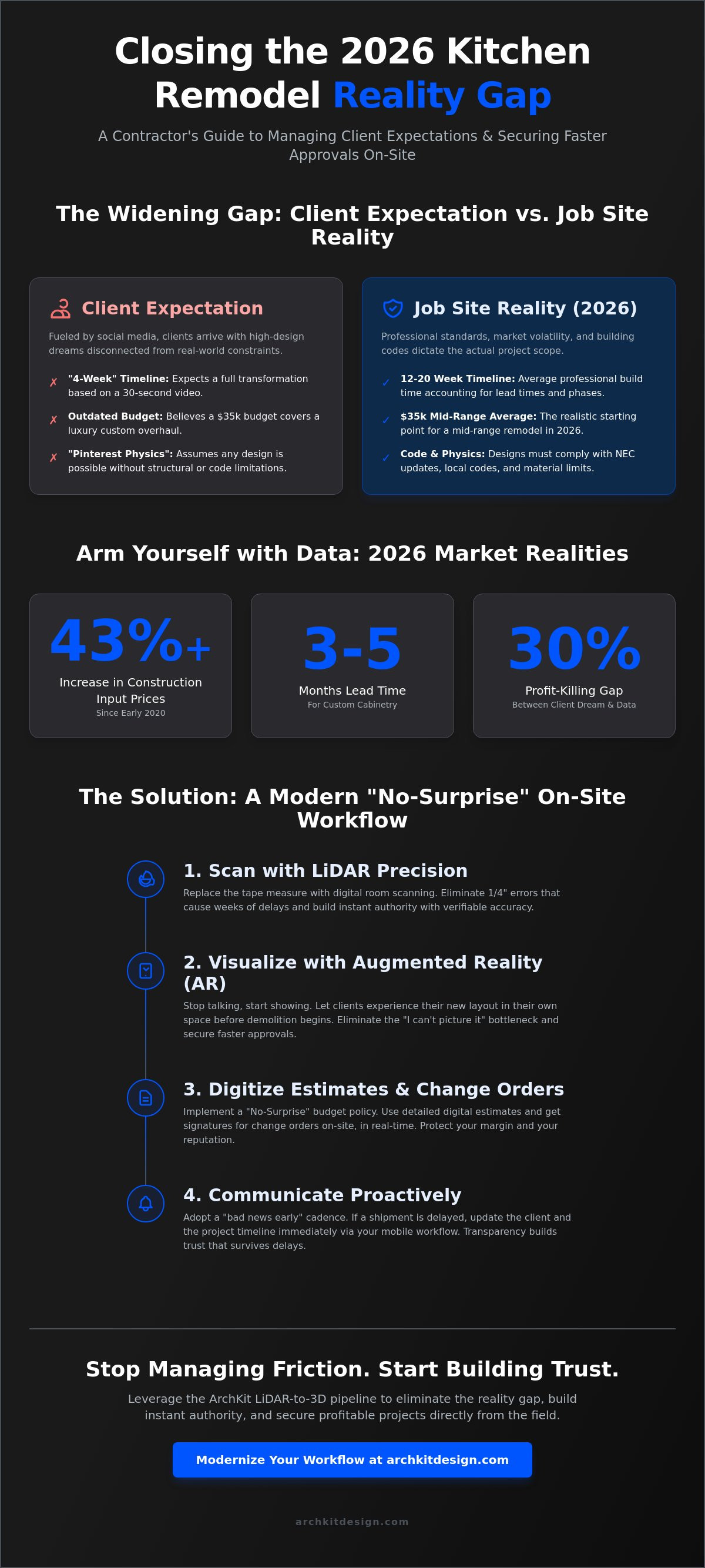
Social media creates a "30-minute makeover" mindset. Clients watch a reel and expect a full transformation in weeks. The reality of 2026 involves a 3-5 month lead time for custom cabinetry. Sticker shock is also a major factor. With construction input prices up over 43% since early 2020, a mid-range kitchen remodel now averages $35,000. Be direct about these figures. Explain that the 4-6% cost escalation in 2026 is a market reality. Use data to replace emotion.
Why "Good Enough" Measurements No Longer Cut It
Precision is the foundation of trust. A 1/4 inch measurement error can cause weeks of delays for custom components. These mistakes erode professional authority and eat your profit. Modern clients demand "Verifiable Accuracy." They want proof that your plan accounts for the 2023 NEC updates for island outlets or NYC’s 2025-2026 electrical codes for induction ranges. Using a free kitchen design app with LiDAR scanning provides this proof instantly. Digital room scanning replaces the tape measure with a high-velocity digital workflow, making managing client expectations kitchen remodel a seamless part of your on-site visit.
Establishing the Framework: Budget and Timeline Transparency
Trust is fragile. One missed deadline or surprise invoice can destroy a referral. 2026 contractors don't rely on handshakes. They use digital footprints. This is the core of managing client expectations kitchen remodel. Establish a "No-Surprise" budget policy using detailed digital estimates from the start. Document every change order instantly. Digital records protect your margin and your reputation. In an era of high material volatility, verbal agreements are a liability. Move fast. Get it in writing. Secure the signature on-site.
Effective communication requires a "bad news early" cadence. Bad news doesn't age well. If a cabinet shipment is delayed, tell the client within the hour. Use your mobile workflow to update the project timeline immediately. This transparency builds professional authority. It shows the client you're in control of the variables, even when the supply chain isn't. State-specific consumer protection laws for contractors often mandate these clear, written disclosures to prevent disputes. Stay compliant. Stay profitable.
The 2026 Timeline: Managing the 4-Week Myth
Clients see a 30-second reel and expect a 4-week build. It's a myth. Professional builds in 2026 take 12 to 20 weeks. Break the process down into phases: Demo, Rough-in, Cabinets, Counters, and Finish. "We schedule a 10-day buffer zone to absorb potential shipping delays or sub-contractor shifts without moving your final completion date." Use this checklist to prepare your clients for demo day:
- Pack all breakables and clear the countertops.
- Clear a wide path from the entrance to the kitchen.
- Set up a temporary cooking station in a separate room.
- Secure pets and sensitive electronics from dust.
Budgeting for the Unknown
Hidden costs aren't a secret. They're a certainty. Explain the 10-20% contingency fund as insurance against job site physics. Use visual layout tools to show the client where plumbing and electrical work lives behind the walls. This makes the "unseen" costs tangible. Link pricing to specific cabinet catalog choices during the first walkthrough to lock in numbers early. To keep your estimates accurate and your clients informed from day one, sign up for early access to our modern workflow tools. This proactive approach is the best way of managing client expectations kitchen remodel while protecting your bottom line.
Visual Communication: Closing the Gap with 3D and AR
Portfolio photos build trust, but they don't solve the visualization problem. Your client isn't looking for "a" kitchen; they're looking for their kitchen. 2D floor plans are professional abstractions that often leave homeowners confused. This confusion is a breeding ground for mid-project "pivots" that destroy your schedule. If they can't see it, they can't trust it. You need a way to make the invisible visible before the first demo bag is filled.
Augmented Reality (AR) changes the conversation entirely. It allows for managing client expectations kitchen remodel by letting the homeowner "stand" in the finished space before you swing a sledgehammer. By projecting digital cabinets onto real-world walls, you eliminate the "I didn't realize it would look like that" excuse. This isn't just a gimmick. It is a core part of modern client management best practices that protects your profit margins. When clients see the final result first, change order anxiety disappears.
From "Imagine This" to "See This"
Industry data suggests that roughly 60% of clients struggle to translate 2D blueprints into 3D spatial reality. They can't feel the walkway clearances or the island spacing just by looking at lines on paper. Use AR to test these clearances in real-time. Place a digital 36-inch cabinet. Check the door swing. Verify the 42-inch walkway. When they see the spatial logic with their own eyes, the design is validated. Use a free kitchen design app to turn a vague "maybe" into a hard "yes" while still on-site. This immediate feedback loop stops design delays before they start.
Tech Comparison: Manual vs. Digital Visualization
Traditional methods are failing the modern contractor. Hand sketches are fast but lack the accuracy needed for custom cabinetry. Desktop CAD is precise but tethers you to an office chair, creating days of lag time between meetings. Mobile AR apps, powered by LiDAR, bridge this gap. They deliver the accuracy of CAD with the speed of a sketch.
| Method | Speed | Accuracy | Client "Wow" Factor | Approval Speed |
|---|---|---|---|---|
| Hand Sketches | High | Low | Low | Slow |
| Desktop CAD | Low | High | Medium | Delayed |
| Mobile AR (ArchKit) | High | High | Maximum | Instant |
LiDAR scanning makes this workflow possible. It captures the room's geometry in seconds. No more measuring twice and still getting it wrong. Scan the room. Place the layout. Close the sale. It's a "no-nonsense" approach that values your time and the client's peace of mind. By using tools like ArchKit, you provide instant professional authority that a paper drawing simply can't match.
Real-Time Revision Management: Handling Changes On-Site
"The Pivot" is the moment a client’s vision shifts mid-walkthrough. It usually triggers a week of administrative lag. You leave the site. You drive to the office. You fire up the desktop CAD and email a PDF. By then, the project momentum is dead. Effective managing client expectations kitchen remodel means resolving these shifts before you leave the driveway. Eliminate the "I’ll go back to the office" delay. Use mobile tools to update layouts and estimates during the site visit. This immediate response maintains your professional authority and keeps the project moving.
Digital sign-offs are your best defense against "he-said-she-said" disputes. When a client requests a change, update the digital model and the estimate on your tablet or phone. Ask for a digital signature right there. This creates an instant, unchangeable record of the agreement. It protects your profit margin from scope creep. It ensures the client understands the cost of their choices. In 2026, a digital footprint is the only way to manage a complex remodel without losing your mind or your money.
The Mobile Workflow Advantage
Modern hardware turns your phone into a design studio. Scan the room using LiDAR. Establish a baseline in seconds. Drop in cabinet layouts from a standard catalog to show immediate options. This high-velocity approach allows you to test ideas without moving a single tool. Use the ArchKit kitchen design app for iPhone to demonstrate this speed to your clients. You aren't just guessing. You're showing them the physical reality of their choices on the spot.
Reducing the Revision Loop
Endless tweaking kills productivity. Set a hard limit on free revisions in your initial contract. Three is often the industry standard. Use digital estimating to show the immediate budget impact of a layout change. When a client sees that moving the sink adds $1,500 to the plumbing rough-in, they think twice about "just seeing how it looks." This instant feedback reduces the desire to keep tweaking. It grounds the design process in financial reality. To start closing the gap between design and construction today, get early access to our on-site workflow tools. Stop the revision loop and start building.
Modernizing the Client Experience with ArchKit
ArchKit serves as the final bridge. It connects your technical efficiency directly to the client's emotional satisfaction. Using a LiDAR-to-3D pipeline provides instant professional authority. You aren't just another contractor with a tape measure and a notepad. You're a specialist with a high-velocity digital solution. Managing client expectations kitchen remodel is about more than talk. It's about replacing vague promises with visual proof. When you show a client their future kitchen in high-definition AR, the "reality gap" disappears instantly.
Ground your estimates in physical reality. ArchKit integrates a standard U.S. cabinet catalog into the workflow. This ensures your layout reflects what you can actually order, ship, and install. No more designing on the fly only to find out the chosen pieces don't fit the budget or the room's localized specifications. Faster approvals mean faster project starts. Get to "Yes" before you leave the driveway. It is about being a more professional and successful business owner who secures more contracts through accuracy.
Professionalism Through Technology
Perception is reality on the job site. Using an iPad Pro LiDAR scanner app separates you from the "truck and a ladder" competition. Provide a 2D and 3D layout before you finish the first consultation. This level of service builds immediate trust and eliminates the administrative fatigue of office-dependent design loops. Review the ArchKit pricing to see how this technology fits your business scale. It's a tool built by people who understand the high stakes of accuracy in demanding environments.
Streamlining the Approval Process
Follow a simple, rhythmic four-step workflow: Scan. Design. Visualize. Approve. This linear process removes friction and moves the reader through a logical funnel. Reduce measurement errors to zero. Ensure a smooth installation day with precise digital data that accounts for every corner and plumbing stack. Don't let stationary office equipment slow your momentum. Start modernizing your business today. You can get early access to start managing client expectations kitchen remodel with confidence. Scan, design, and sign. It’s that simple.
Take Control of Your Kitchen Projects Today
Winning in 2026 requires more than just trade skills. It requires a workflow that bridges the gap between client dreams and job site physics. You've seen how transparency in budgets and timelines prevents friction. You know that visual proof beats verbal promises every time. Managing client expectations kitchen remodel is now a game of speed and accuracy. Don't let manual processes slow your momentum.
Stop losing hours to office-bound design loops. Replace your tape measure with LiDAR-powered precision. Use standard U.S. cabinet catalog integration to keep your estimates grounded. Show your clients the final result instantly with 3D AR visualization. This isn't just about convenience. It's about securing more contracts and protecting your profit margins. The era of the "truck and a ladder" contractor is over. Professionalism is now digital, immediate, and verifiable.
Stop guessing and start scanning. Get Early Access to ArchKit today. Build with confidence. Your next high-referral project starts with a single scan.
Frequently Asked Questions
How do I handle a client who insists on an impossible timeline?
Lead with the data. Tell them the truth. In 2026, a professional mid-range remodel takes 12 to 20 weeks. Don't promise what you can't deliver. Show them the phase breakdown: demo, rough-in, cabinets, counters, and finish. Use this timeline to replace emotion with physics. If they won't budge, walk away. Protecting your reputation is more valuable than a bad contract.
What is the best way to explain "change order" costs without losing trust?
Implement a "No-Surprise" budget policy. Show the physical reality behind the walls. Use visual layout tools to demonstrate how moving a sink impacts plumbing and electric. Link costs to specific choices early. When the client sees the budget impact instantly on-site, trust remains high. It becomes a choice they made, not a fee you invented. Digital footprints prevent disputes.
Can AR visualization actually help close more kitchen remodeling contracts?
Yes. AR visualization turns a vague "maybe" into a hard "yes" instantly. It allows for managing client expectations kitchen remodel by letting homeowners stand in their future space. They see the walkway clearances and island spacing before you swing a hammer. This eliminates the "I didn't realize it would look like that" excuse. Faster visualization means faster project starts and fewer revisions.
How much should I charge for the initial design and measurement phase?
Charge for your time and expertise. Most professionals use a design retainer or a measurement fee to filter out tire-kickers. This covers the cost of your digital tools and professional authority. Don't give away your LiDAR scans for free. Positioning this as a "Project Launch Phase" establishes value. It ensures you are paid for the critical work done before demo day.
What happens if my digital measurements don’t match the final cabinet order?
Use LiDAR to reduce errors to zero. Digital scanning captures room geometry in seconds. If a discrepancy occurs, check your digital baseline. ArchKit helps by grounding designs in a standard U.S. cabinet catalog. This ensures your layout reflects real-world specifications. Always verify the 1/4 inch details before ordering custom pieces. Digital footprints provide a record that protects your profit margin.
How do I transition my traditional business to a mobile-first digital workflow?
Start on the job site. Reject stationary office equipment that causes delays. Adopt a mobile workflow that allows for on-location design and estimating. Use an iPad Pro with LiDAR. Transitioning to a tool like ArchKit allows you to scan, design, and get sign-off in one visit. This modernization increases your competitive edge and secures more contracts. Move fast. Stay mobile. Get results.
Is LiDAR scanning accurate enough for custom cabinetry layouts?
Yes. LiDAR provides high-velocity precision for professional trade standards. It captures the exact dimensions of a room, including walls, windows, and obstructions. This technology handles the high stakes of accuracy required for custom cabinetry. It removes the burden of manual measurement fatigue. You get a perfect digital twin of the kitchen in seconds. It is the modern standard for professional remodelers.
How do I manage expectations for smart kitchen technology integration?
Address the 2026 shift toward smart kitchens early. Managing client expectations kitchen remodel includes discussing high-load appliances like induction ranges. Refer to local electrical codes, such as NYC’s 2025-2026 requirements. Use your digital layout to show where smart hubs and island outlets will live. Be direct about the infrastructure needed. Don't let smart tech become a mid-project surprise. Plan for it on day one.


