
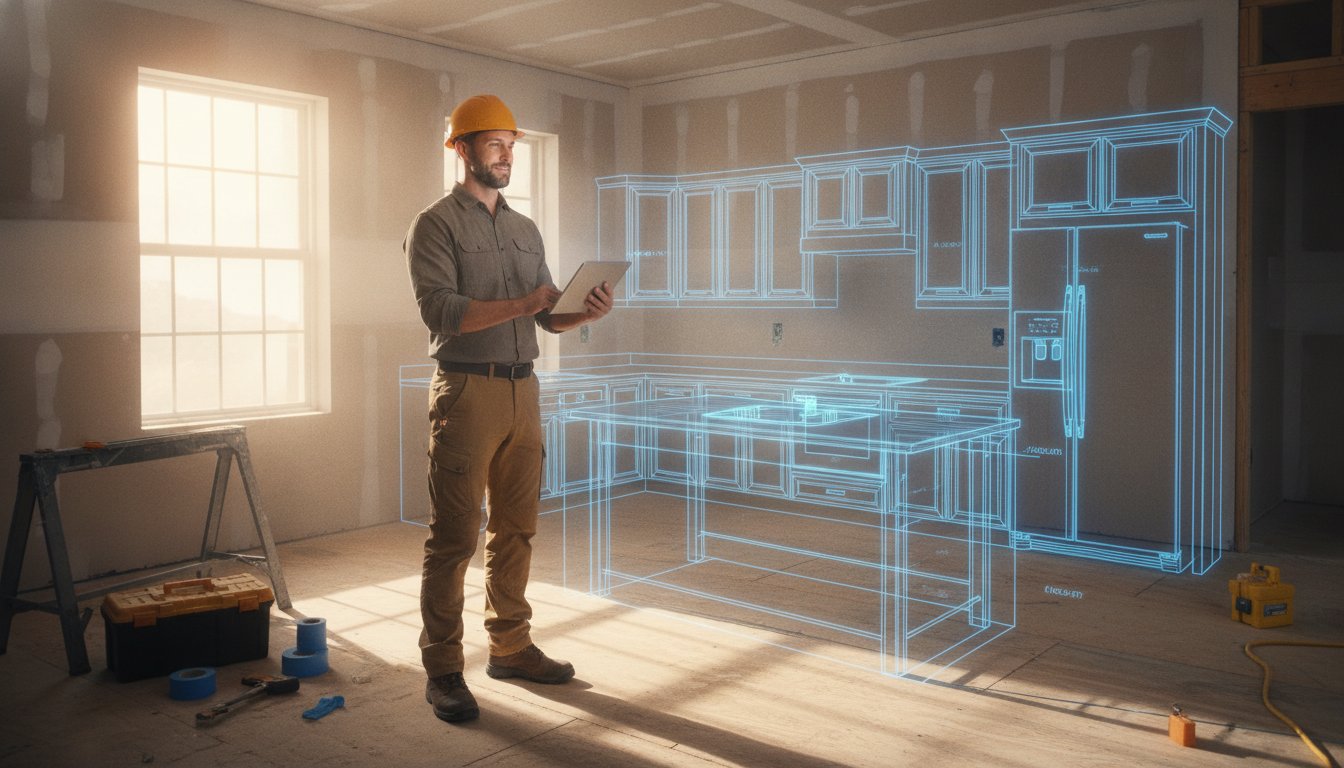
Did you know that labor costs can consume up to 40% of a kitchen remodel budget? When that figure climbs because of cabinet misfits or overlooked site conditions, your profit margin vanishes. You already know that the difference between a profitable project and a break-even headache is the accuracy of your first walkthrough. It's frustrating to lose leads to faster competitors while you're stuck in the office crunching numbers from a notepad.
Learning how to estimate labor costs for kitchen remodel jobs with precision is about moving beyond manual errors. You can protect your margins by adopting a mobile-first approach that captures every dimension perfectly. This guide teaches you to master on-site estimation using LiDAR and AR technology to eliminate the re-visit trap. We will show you how to use ArchKit Design to create zero-error layouts and professional 3D presentations that justify higher rates. Scan the room. Design the layout. Close the deal. You'll gain the tools to deliver faster bids and secure more contracts without the administrative weight.
Key Takeaways
- Stop profit leaks by identifying the "re-visit trap" caused by manual measurement errors. Protect your margins with dimensional precision.
- Discover how to estimate labor costs for kitchen remodel projects using a mobile-first workflow. Replace slow office homework with immediate on-site results.
- Compare traditional bidding against digital workflows to see how LiDAR scanning and 2D/3D layout tools slash bid delivery times.
- Master a 5-step process using ArchKit Design to capture site geometry and build layouts using standard cabinetry catalogs in minutes.
- Use AR visualization to justify professional labor rates. Reduce unpaid design revisions by giving clients a clear vision of the finished project.
Why Inaccurate Labor Bids Kill Contractor Margins
Many contractors treat the initial walkthrough like a casual conversation. It is actually the most expensive hour of your work week. If you get it wrong, you don't just lose time; you lose your profit. Labor costs typically consume 15% to 40% of a kitchen budget. A small mistake in calculating these hours turns a profitable job into a charity project. Knowing how to estimate labor costs for kitchen remodel projects starts with identifying exactly where the money leaks before the first sledgehammer swings.
Manual measurements are the root cause of the "re-visit trap." You miss a plumbing vent or misread a tape measure. Suddenly, the custom cabinets don't fit the wall. You are back on-site for a "quick fix" that takes four hours of unbilled labor. These second trips are margin killers. They destroy your schedule and eat the overhead meant for your next project. Precision on day one is the only way to protect your bottom line.
Understanding Margin Erosion and Scope Creep
Scope creep is the silent killer of contractor profitability. It happens when small, unbilled tasks pile up because the initial cost estimate lacked detail. In kitchen remodeling, a 1/4-inch measurement error ruins a custom cabinet labor schedule. If the box doesn't slide into place, your crew spends hours scribing and shimming. You cannot charge for that extra time if your bid was vague. Specificity in cabinetry and plumbing layouts prevents these hidden costs from eroding your paycheck.
The Speed-to-Lead Advantage in 2026
The market in 2026 moves at high velocity. Homeowners expect a bid while you are still standing in their kitchen. Contractors who deliver a professional bid within 24 hours have a significantly higher closing rate than those who wait a week. Traditional paper-and-pencil workflows create too much friction. You take notes, go home, and spend hours on desktop CAD software. That is unpaid office homework.
Digital workflows change the game. Using a kitchen design app for iPhone allows you to design on-site. You capture the room with LiDAR, drop in cabinets, and generate a bid before you leave the driveway. This eliminates the delay that allows tech-savvy competitors to steal your leads. Stop doing CAD work at your kitchen table at 9:00 PM. Move your office to the job site and close deals faster.
Vague labor quotes also damage client trust. If you tell a homeowner that labor is "around ten thousand," they hear a guess. If you show them a 3D layout with specific hours for demolition and MEP coordination, they see a professional. Precision justifies your rates and makes the approval process seamless.
The Four Pillars of a Precise Kitchen Labor Estimate
Precise labor bidding isn't about guessing. It's about hard data. According to NAHB's cost-of-doing-business surveys, managing overhead and profit is only possible if your labor base is accurate. To master how to estimate labor costs for kitchen remodel projects, you must build your bid on four pillars: dimensional accuracy, trade coordination, cabinetry precision, and the "complexity tax" of the existing structure. If one pillar is weak, the entire project's profitability is at risk.
Dimensional accuracy is the non-negotiable foundation. If your measurements are off by even a fraction, every subsequent labor calculation for flooring, countertops, and backsplash tile will be wrong. Trade coordination follows closely. You must account for every hour of demolition and MEP (mechanical, electrical, and plumbing) work. This includes the time spent waiting for inspections or coordinating with specialized subcontractors. When these pillars are solid, you stop reacting to problems and start managing a schedule.
Cabinetry Installation and Finish Carpentry
Accurate installation bids depend entirely on your layout precision. Using U.S. standard cabinet sizes allows you to predict exactly how many hours your crew will spend hanging boxes. Digital tools help you generate automated cabinet lists, which prevents ordering errors that lead to expensive labor delays. Don't overlook the finish work. Crown molding, decorative hardware, and specialized storage inserts often take more time than the cabinets themselves. Factor in these finish carpentry hours separately to keep your bid realistic and your margins protected.
Mechanical, Electrical, and Plumbing (MEP) Coordination
Moving utility stubs is a major labor driver that can blow a budget. It's significantly more labor-intensive to trench a slab for a new island sink than to use existing locations. LiDAR mapping helps you identify plumbing and electrical obstacles behind walls before you start demolition. This high-tech approach allows you to coordinate subcontractor schedules within your master bid with zero guesswork. If you want to see how LiDAR simplifies on-site planning, you can get early access to our professional workflow tools.
Demolition and Site Preparation
Demolition is more than just swinging a hammer. You must calculate hours for debris removal, dust containment, and structural protection of adjacent rooms. Old kitchen tear-outs often hide "unseen" labor costs like rotted subfloors or non-standard wall framing. Always factor in subfloor leveling and wall squaring labor from the start. In older homes, the complexity tax is real. Scribing cabinets to a wavy wall or leveling a sagging joist takes time that a generic bid won't cover. When you learn how to estimate labor costs for kitchen remodel work, always assume the walls aren't square until you prove otherwise.
Manual vs. Digital Bidding: Protecting Your Time
Time is your most finite resource. Spending hours at a desk transcribing chicken-scratch notes into a spreadsheet isn't just tedious; it's unprofitable. When you analyze how to estimate labor costs for kitchen remodel projects, the method you choose determines your speed-to-lead. Manual bidding relies on memory and paper. It creates a massive drafting bottleneck that delays project start dates. Digital bidding moves that work to the job site. It turns your walkthrough into a live design session.
Digital tools provide high precision and immediate results. You capture the room, build the layout, and calculate labor hours while the client is still excited. This on-site mobility eliminates the need for office homework. It also protects your schedule from the re-visit trap. Professional 3D visualization acts as a catalyst for homeowner decision-making. Clients stop questioning your labor rates when they can see exactly what they're paying for in a high-fidelity model. High speed equals high trust.
The Failure of Hand-Drawn Floor Plans
Hand-drawn sketches are a liability. Transcribing field notes into office software often leads to critical errors. A smeared number or a forgotten wall thickness results in a cabinetry misfit. The hidden cost of manual data entry for cabinetry takeoffs is staggering. You spend hours double-checking lists that a computer could generate in seconds. Beyond the math, paper sketches fail to communicate professional authority. In a competitive market, a pencil drawing looks like a hobby. A digital model looks like a plan. Don't let a messy notepad sink your reputation.
Leveraging Mobile CAD for On-Site Efficiency
Modern contractors carry their office in their pocket. Using mobile CAD for kitchen design enables instant layout iterations. You can move a sink or add a pantry with a swipe. This speed allows you to address client concerns in real time. Having a digital cabinetry layout tool ensures every box fits perfectly within the scanned geometry. Mobile tools empower you to design with the client on-site, building trust through collaboration rather than a detached office process. You leave the house with an approved concept, not a to-do list. This efficiency is the secret to scaling your business without adding administrative weight. Capture the room. Design the dream. Close the lead.
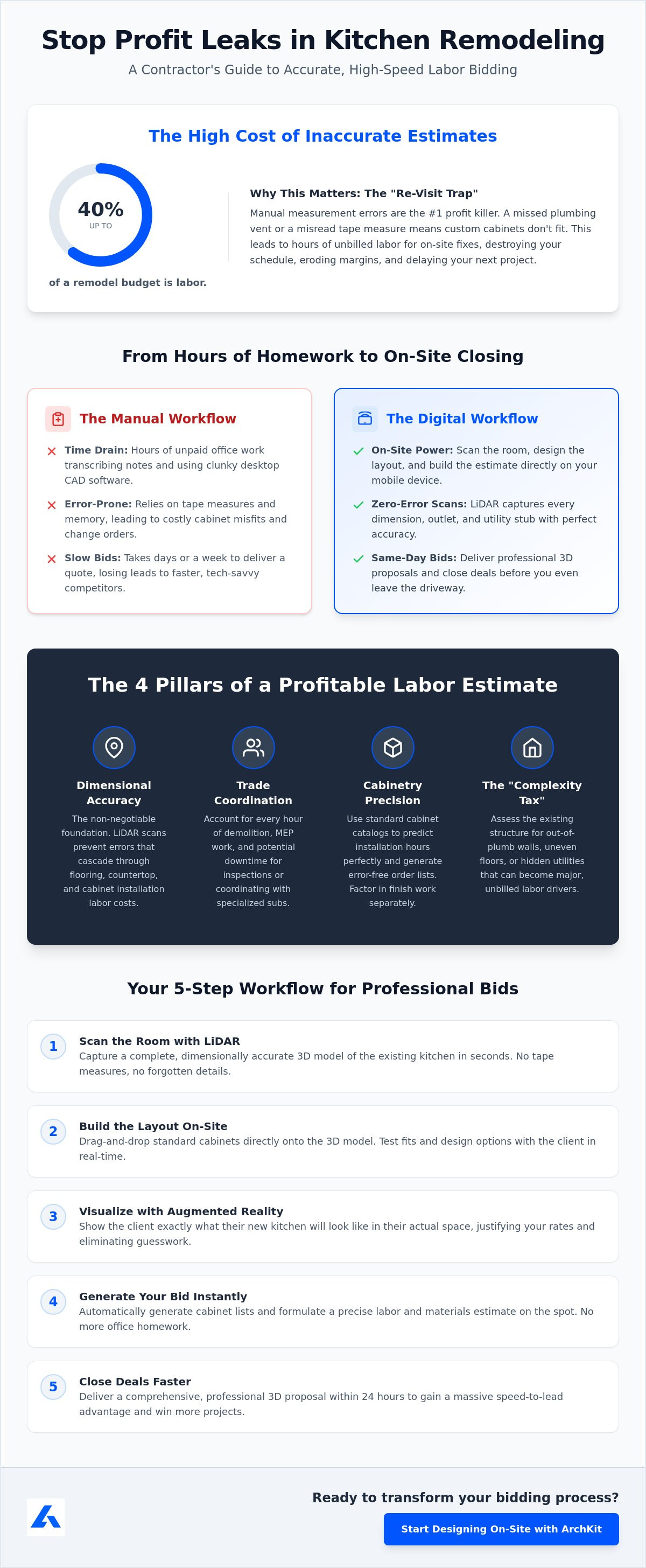
The 5-Step Workflow for a Professional Labor Bid
Stop treating your office like a sanctuary for paperwork. In 2026, the most successful contractors close deals before they leave the job site. Bidding is no longer a sedentary task; it is a field operation. This 5-step workflow transforms the way you approach every consultation. It moves the complexity of the office into the palm of your hand, allowing you to provide a precise bid with total confidence.
- Step 1: Consultation and LiDAR scanning. Capture the room's 3D geometry immediately.
- Step 2: Rapid layout. Use standard cabinetry catalogs to test design feasibility on-site.
- Step 3: Rate integration. Apply your specific labor rates for demolition, MEP coordination, and installation.
- Step 4: AR walkthrough. Use augmented reality to validate the design with the client in their actual space.
- Step 5: Digital approval. Deliver the bid instantly and secure a digital signature to start the project.
This process ensures that you never leave a house without a clear path forward. It eliminates the days of "thinking about it" that often lead to ghosted leads. When you master how to estimate labor costs for kitchen remodel projects using this high-velocity workflow, you aren't just guessing. You are building a data-driven proposal that protects your time and your profit.
On-Site Scanning and Layout Strategy
Accuracy begins with the scan. You can perform a full LiDAR kitchen scan in under 5 minutes. This digital twin of the room captures every wall, window, and utility stub with millimeter precision. Once the room is captured, place standard cabinets immediately to test layout feasibility. This allows you to identify structural obstacles, like non-load-bearing walls or plumbing stacks, before you finalize the labor quote. You see the problems now, not during week three of the build.
Real-Time Pricing and Profit Calculation
Link your layout directly to your labor and material pricing to keep the math simple. If a client wants to move the sink to the island, you can handle the revision on-site. The software updates the labor hours for plumbing and floor trenching instantly. This transparency ensures gross profit margins are protected during the negotiation phase. You don't have to "guess" if a change is profitable. You see the impact on your bottom line in real time. To start closing more deals with this level of precision, get early access to ArchKit Design and modernize your bidding process today.
Closing the Sale: Using AR to Justify Your Labor Rates
You have done the math. You have accounted for the complexity tax of the old structure and the precision of the new cabinetry. Now you have to justify the price. Homeowners often struggle with the cost of skilled labor because they cannot see the work behind it. Visualization is the ultimate antidote to client sticker shock. When you show a homeowner a 3D model of their new kitchen, the conversation shifts from price to value. They stop looking at the bottom line and start looking at their new reality. Knowing how to estimate labor costs for kitchen remodel projects is only half the battle; the other half is proving that your expertise is worth the investment.
The Psychological Advantage of AR Visualization
AR builds an immediate emotional investment by showing the future in the present. By overlaying the new cabinetry layout onto their existing walls, you reduce client decision fatigue. They don't have to imagine where the island goes; they can walk around it. Seeing the design in their own space creates a sense of ownership before the contract is even signed. This visual proof justifies your professional labor rates by demonstrating the complexity and care involved in the layout. ArchKit Design bridges the gap between a quote and a dream. It turns a list of labor hours into a tangible project that feels real to the homeowner.
Streamlining the Approval Process
Eliminate the "I'll get back to you" phase. Modern clients want immediate visual answers. When you provide a high-fidelity 3D walkthrough on-site, you answer visual questions instantly. This speed reduces the frequency of unpaid design revisions. If they want to see a different cabinet style, change it in the app. If they want to move the range, do it now. This real-time collaboration leads to fewer change orders during construction. You have already solved the layout puzzles together. Accurate bids based on LiDAR scans mean fewer surprises that require expensive labor corrections later.
Finalize the deal with confidence. Building professional authority requires more than a tape measure. It requires a tech-forward presentation that mirrors the quality of your craftsmanship. Once the client sees the value and approves the design, move to digital signatures. Clear next steps prevent leads from cooling off. You have used LiDAR to ensure accuracy and AR to build trust. Now, secure the project. Stop wasting time on manual bids. Get early access to ArchKit Design now.
Modernize Your Bidding Workflow Today
Winning more contracts in 2026 requires more than just a tape measure. It requires a system that eliminates the guesswork and protects your profit. You have learned that mastering how to estimate labor costs for kitchen remodel projects successfully depends on three core elements: dimensional precision, trade coordination, and professional presentation. Stop doing unpaid office homework at your kitchen table. Move your entire bidding process to the job site where the work actually happens.
LiDAR-powered precision mapping ensures your cabinetry layout fits perfectly the first time. Instant 3D and AR visualization justify your professional rates and close the sale before you leave the driveway. By integrating standard U.S. cabinet catalogs directly into your mobile workflow, you remove the friction of manual takeoffs and data entry. It is time to protect your margins, eliminate the re-visit trap, and reclaim your evenings.
Master your on-site bidding with ArchKit. Build a more profitable business with digital tools designed for the physical reality of the job site. You already have the craftsmanship; now give yourself the competitive edge of speed and accuracy.
Frequently Asked Questions
How do I accurately calculate labor costs for a kitchen remodel?
Base your calculation on specific labor hours for demolition, MEP coordination, and installation rather than a flat percentage. Use standard cabinetry catalogs to predict hanging times and include a complexity tax for structural corrections in older homes. This data-driven approach ensures you know how to estimate labor costs for kitchen remodel projects without eroding your profit margins or missing hidden site conditions.
Is LiDAR scanning accurate enough for custom kitchen cabinetry?
Modern LiDAR technology captures room geometry with millimeter precision, making it ideal for custom cabinet layouts. It identifies wall deviations and plumbing locations that a tape measure might miss. Using a tool like ArchKit allows you to create a digital twin of the site instantly. This eliminates the re-visit trap and ensures your custom boxes fit the space perfectly on the first attempt.
How can I bid a kitchen remodel faster without losing accuracy?
Move your bidding process to the job site using mobile workflows. Instead of taking notes and doing office homework later, use LiDAR to scan the room and generate a layout immediately. This speed-to-lead advantage allows you to deliver a professional bid within 24 hours. Digital automation handles the math, reducing the risk of manual transcription errors while significantly slashing your administrative time.
What should be included in a professional kitchen remodel bid?
A professional bid must include detailed line items for demolition, material disposal, MEP coordination, and cabinetry installation. Specify the scope of work for subfloor leveling and wall squaring to prevent scope creep. Including a 3D visualization or AR walkthrough helps justify your labor rates. This transparency builds client trust and ensures everyone understands the project requirements before the first sledgehammer swings.
How do I handle client requests for design changes during the bidding process?
Address design changes in real time using mobile layout software while you are still on-site. If a client wants to move a sink or add a pantry, update the digital model instantly to show the impact on labor hours. This immediate feedback prevents the back and forth delays of traditional drafting. You can finalize the scope and pricing together, ensuring the gross profit margin remains protected.
What is the best way to present a 3D kitchen layout to a client on-site?
Use Augmented Reality (AR) to overlay the 3D layout directly onto the client's existing kitchen walls. This immersive experience helps homeowners visualize the future in the present, which reduces decision fatigue and sticker shock. Presenting a high-fidelity model on an iPad demonstrates your professional authority. It shifts the conversation from a vague quote to a tangible dream they can walk through.
How much profit margin should a contractor add to a kitchen remodel job?
While regional standards vary, many successful contractors target a 15% to 25% overhead and profit margin. This markup is added on top of your direct labor and material costs. Use accurate on-site data to ensure your base costs are solid before applying your margin. This protection is vital when you learn how to estimate labor costs for kitchen remodel work, especially in complex environments.
Can I use an iPad to create a kitchen bid while at the client home?
Absolutely. Using an iPad with ArchKit allows you to perform LiDAR scans, place cabinetry, and generate a professional bid before leaving the driveway. The large screen is perfect for showing AR walkthroughs and 3D models to homeowners. This mobile-first approach replaces stationary office equipment with a powerful, portable tool. It empowers you to close deals faster and eliminate the drafting bottleneck entirely.


