

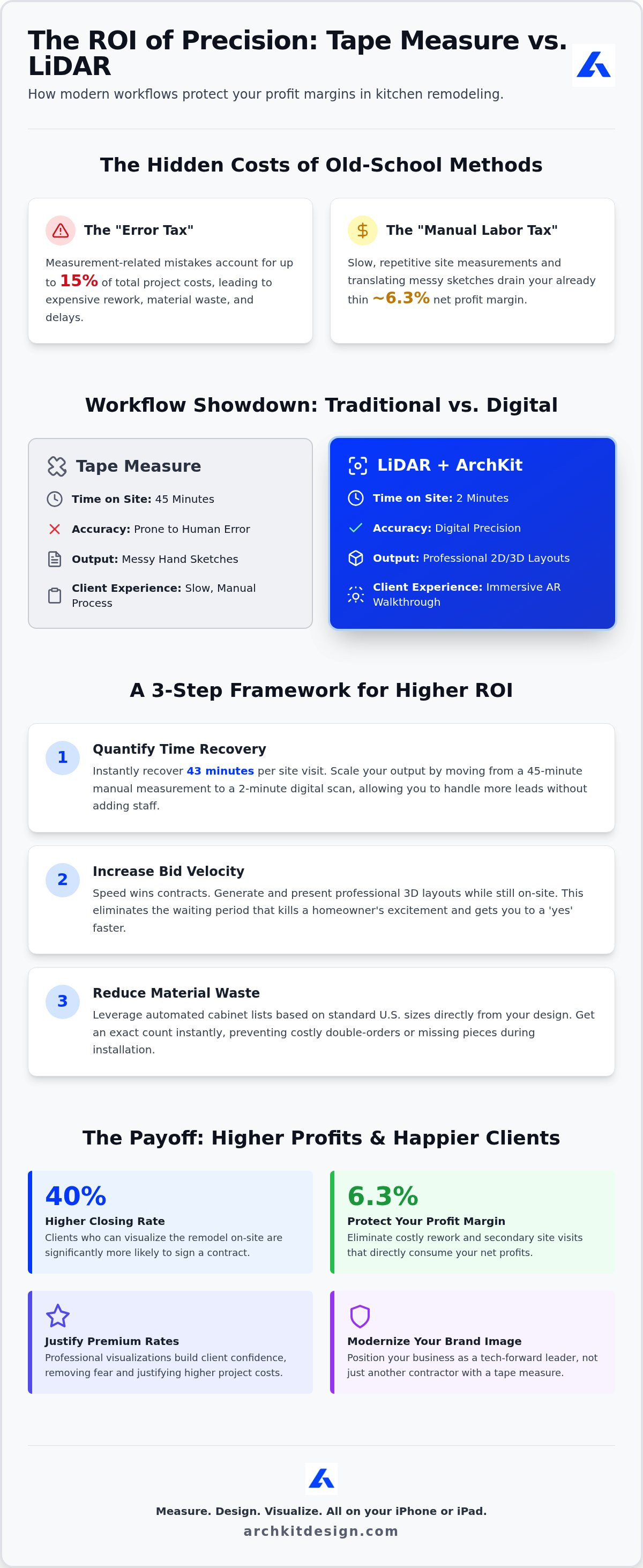
Did you know that measurement-related errors account for up to 15% of total project costs? In an industry where net profit margins often sit around 6.3%, those small mistakes aren't just annoying; they're expensive. You're likely tired of manual measurements that delay your bidding process or cause costly rework during cabinet installation. It's time to stop viewing your measurement process as an overhead expense.
This guide introduces a 2026 ROI framework to transform your field workflow into a high-speed profit driver. We'll compare a tape measure vs LiDAR for kitchen remodels to show how digital precision protects your bottom line. You'll learn how ArchKit Design helps you reduce site time from hours to minutes while increasing your bid closing rates with professional visualizations. Let's move beyond the manual labor tax and start driving higher profits today.
Key Takeaways
- Eliminate the "Manual Labor Tax" by identifying how slow site measurements and repetitive manual errors drain your net profit.
- Apply a 2026 ROI framework to evaluate a tape measure vs LiDAR for kitchen remodels, focusing on time recovery and immediate data accuracy.
- Increase your bid velocity by using ArchKit Design to generate professional 2D and 3D layouts directly from your iPhone or iPad while still on-site.
- Secure higher closing rates by replacing hand sketches with immersive AR visualizations that build client trust and justify premium project rates.
The Hidden Cost of Manual Tape Measures in Kitchen Remodeling
A tape measure feels free because it costs twenty dollars at the hardware store. That's a myth. Every time you pull that tape, you're paying a "Manual Labor Tax." This tax is the hidden cost of repetitive, slow site measurements that eat your profit. When evaluating a tape measure vs LiDAR for kitchen remodels, don't look at the tool's price tag. Look at the labor hours. A single professional using traditional methods spends forty-five minutes on a basic layout. LiDAR acts as a force multiplier. It captures that same space in seconds, scaling your output without adding staff.
To understand the tech, you might ask What is LiDAR? It's a remote sensing method using light to measure ranges. It creates a precise digital twin of the room. It turns a manual chore into high-speed data capture.
Calculating the 'Error Tax' on Your Projects
Measurement errors aren't just annoying. They're expensive. These mistakes drain your project budget through rework and lost labor. One mismeasured cabinet or a misplaced wall causes a chain reaction. You lose money on shipping and materials. Then there's "Office Drift." This is the time you lose translating messy sketches into a kitchen design app. It's administrative fatigue. When you settle the debate of tape measure vs LiDAR for kitchen remodels by choosing digital precision, you eliminate this drift. Use a LiDAR room mapping tool to generate accurate 2D and 3D layouts instantly. Move your workflow to the job site. Protect your profit today.
A 3-Step Framework to Compare LiDAR vs. Tape Measure ROI
Stop guessing your profitability. Use this three-step framework to evaluate the return on a tape measure vs LiDAR for kitchen remodels. This isn't just about cool tech. It's about recovering lost labor hours and protecting your bottom line.
- Step 1: Quantify Time Recovery. A manual tape measurement typically takes forty-five minutes. Using LiDAR room mapping takes two minutes. You recover forty-three minutes per site visit. Multiply that by your weekly leads to see the immediate labor savings.
- Step 2: Calculate Bid Velocity. Speed wins contracts. LiDAR allows you to generate a professional 3D layout while standing in the client's kitchen. You aren't just measuring; you're selling. This eliminates the waiting period that often kills a homeowner's excitement.
- Step 3: Reduce Material Waste. Manual lists lead to double-ordering or missing filler pieces. ArchKit Design uses automated cabinet lists based on standard U.S. cabinet sizes. You get an exact count instantly.
Translating Software Features into Profit Margins
Many owners fear monthly costs. However, kitchen design software pricing is negligible compared to one lost afternoon. If a manual error forces a second site visit, you've already spent more on fuel and labor than the software's cost. On-site design eliminates these secondary trips. You finish the job in one visit. This is how you protect your 6.3% net profit margin. You can download the kitchen measurement app to start optimizing your workflow now. Move fast. Capture more revenue.
Securing the 'Yes': Presenting LiDAR as a Competitive Advantage
Don't just sell a renovation. Sell the outcome. When you compare a tape measure vs LiDAR for kitchen remodels, the biggest difference isn't the data. It's the presentation. A hand-drawn sketch on a clipboard signals a manual, slow process. A professional 3D walkthrough signals precision and speed. Choosing a tape measure vs LiDAR for kitchen remodels is ultimately a choice between looking like a hobbyist or a high-end pro. Use technology to build "Client Confidence." Industry data suggests clients are 40% more likely to sign a contract when they can visualize the remodel on-site. This visual proof allows you to charge premium rates because you've removed the homeowner's fear of the unknown.
Leveraging AR Visualization for Immediate Project Approval
Waiting days for a CAD designer to return a floor plan kills project momentum. Use AR for client communication to reduce approval cycles from weeks to minutes. You can walk a client through their new kitchen before you've even left the driveway. This immediate feedback loop keeps the excitement high. It positions your brand as a modern, tech-forward leader.
Presenting accurate 3D models directly from an iPhone or iPad transforms your professional image. You aren't just another contractor with a tape measure. You're a specialist using a kitchen design app to deliver certainty. This level of transparency makes the "Yes" easier for the client to say. It turns your measurement process into your strongest sales tool. Stop leaving money on the table with outdated sketches. Start closing more deals with digital authority.
Modernize Your Workflow to Protect Your Margins
Deciding between a tape measure vs LiDAR for kitchen remodels marks the difference between a business that stays stagnant and one that scales. You've seen how traditional methods invite the manual labor tax, while digital tools recover lost hours and eliminate office drift. By integrating precision measurement with real-time 3D layouts, you're not just improving your accuracy; you're professionalizing your entire brand. Don't let measurement errors or slow bidding cycles continue to erode your 2026 profit goals. Switch to a workflow that values your time and impresses your clients from the first consultation. Measure, design, and visualize with confidence to ensure every project is profitable from day one.
Empower your team to measure, design, and close with speed. Your next successful remodel starts with a single scan.
Frequently Asked Questions
How much should a small remodeling business spend on technology every month?
Aim for a technology budget between 1% and 3% of your gross revenue. This investment should cover your CRM and a specialized kitchen design app. Don't treat this as a sunken cost. Modern software is an infrastructure upgrade. It prevents the labor drain caused by manual office drift. Focus on tools that replace slow, manual processes with immediate, high-value results.
What is the best way to explain SaaS costs to a traditional business owner?
Frame software as a digital tool rental rather than a fixed overhead expense. A subscription for a kitchen measurement app is like renting a laser level. You pay for the immediate utility. Explain that the cost is recovered in the first hour of saved site time. It is a productivity multiplier that scales your output without adding more staff to the payroll.
Can LiDAR technology really reduce project errors in kitchen remodeling?
Yes, LiDAR kitchen measurement captures millions of data points to identify wall deviations that a manual tape misses. When comparing a tape measure vs LiDAR for kitchen remodels, the digital scanner identifies floor slopes and crooked corners instantly. This precision eliminates the risk of ordering cabinets that won't fit. You stop paying for rework and protect your net profit margins.
How do I choose between monthly and annual software subscriptions for my crew?
Use monthly plans to maintain cash flow during seasonal fluctuations or while testing a new cabinet layout tool. This flexibility allows you to scale up or down based on your project load. Switch to annual billing once the tool is a core part of your daily site visits. Annual subscriptions often provide significant discounts, reducing your long-term administrative costs per project.

