

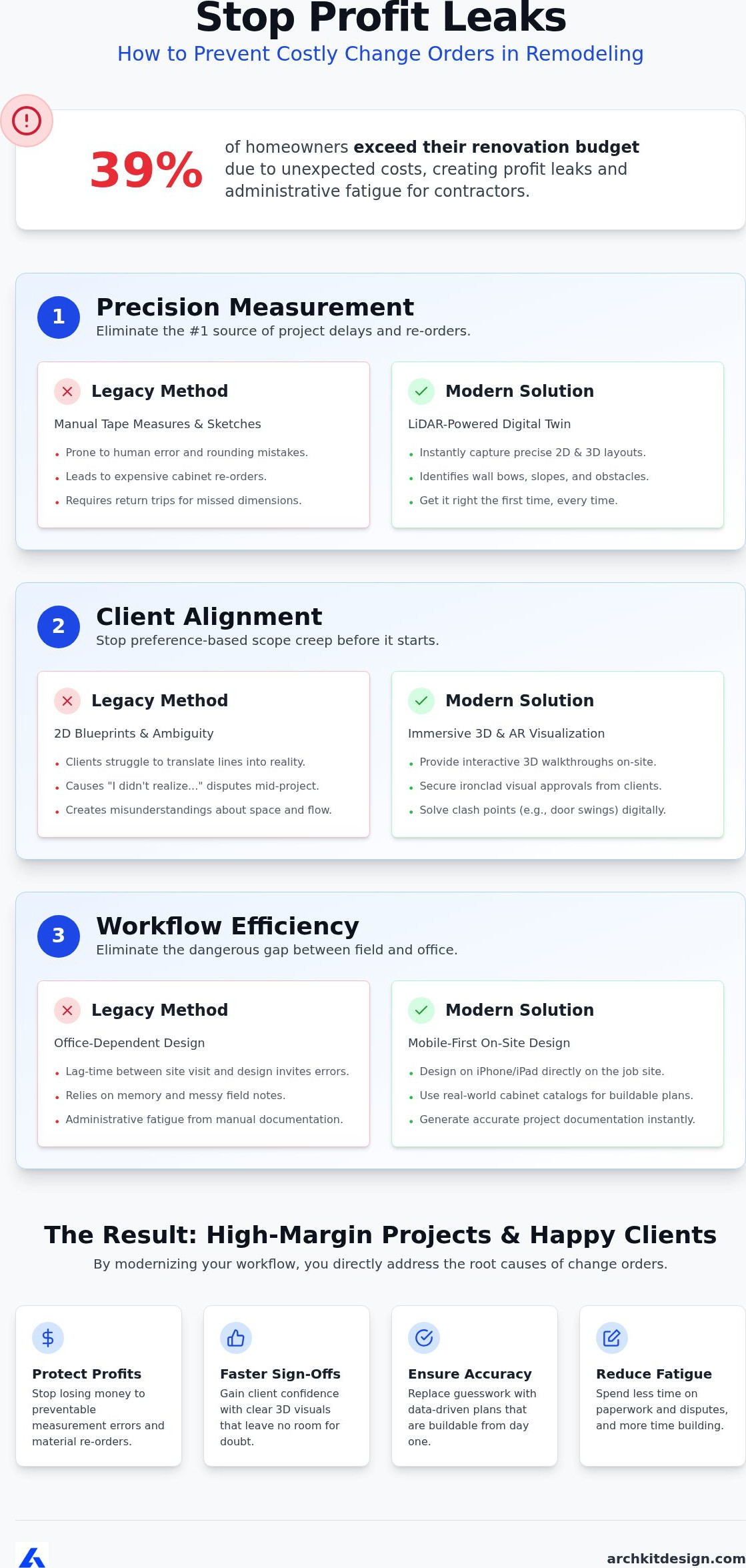
Thirty-nine percent of homeowners exceed their renovation budget because of unexpected costs. For a professional contractor, these surprises usually mean profit leaks and hours of administrative fatigue. You know the frustration of a measurement error that ruins a cabinet order or a client dispute over a design they simply didn't imagine correctly. These setbacks aren't just annoying; they're expensive. Learning how to prevent change orders in remodeling is the difference between a high-margin success and a project that barely breaks even.
Ditch the legacy methods of tape measures and hand-drawn sketches. This guide shows you how to master on-site precision and provide total visual clarity to your clients. We explore how using a professional kitchen design app with LiDAR kitchen measurement eliminates errors before they happen. You'll learn to use 3D kitchen design to secure faster sign-offs. Ensure every cabinet fits to the inch. Stop drafting manual documentation. Start delivering immediate, accurate results that protect your bottom line. It's time to modernize your workflow and keep your profits where they belong.
Key Takeaways
- Eliminate manual measurement errors by using LiDAR technology for instant, precise 2D and 3D layouts on-site.
- Stop preference-based scope creep by aligning client expectations through immersive 3D visualization before construction begins.
- Learn how to prevent change orders in remodeling by designing with real-world cabinet sizes directly on your iPhone or iPad.
- Reduce administrative fatigue and "lag-time" mistakes by generating accurate project documentation while still on the job site.
- Protect your profit margins and secure faster client sign-offs by replacing vague sketches with high-fidelity digital plans.
Eliminating Measurement Errors at the Source
Measurement inaccuracies are the silent killers of project profitability. Traditional tape measures invite human error; they rely on steady hands and subjective rounding that rarely accounts for out-of-plumb walls. Understanding What is a Change Order? is essential for any professional, but mastering how to prevent change orders in remodeling requires moving beyond legacy tools. Digital precision identifies plumbing stacks and electrical obstructions during the very first site visit. "Close enough" measurements lead to expensive cabinet re-orders and labor delays that stall your crew for weeks. Use a kitchen measurement app to capture the truth of the space immediately.
The High Cost of Manual Kitchen Surveys
Manual surveys carry heavy hidden labor costs. Think about the time wasted on return trips just to verify a single missed dimension or a forgotten soffit height. A 1/4-inch error at the start of a project cascades. It turns into a multi-thousand dollar cabinetry problem when the final box won't fit the run. This administrative fatigue eats your margin. Relying on contractor kitchen design software ensures that every dimension is logged correctly the first time, preventing the need for costly field modifications later.
Using LiDAR to Map Real-World Constraints
Modern contractors don't guess. Leverage LiDAR kitchen scanner app technology to capture every wall angle and obstacle instantly. This process creates a digital twin of the job site. You can stress-test your plans using a kitchen layout app before you ever place a material order. LiDAR kitchen measurement reveals the reality of the room, including floor slopes and wall bows that a tape measure might miss. Adopting this high-performance workflow is the most effective way to understand how to prevent change orders in remodeling by catching physical constraints before they become construction roadblocks.
Aligning Client Expectations with 3D Visualization
Visual ambiguity is the primary cause of preference-based scope creep. Most homeowners struggle to translate 2D floor plans into a 3D reality. They sign a contract based on a line on a page, but they don't truly understand the depth, lighting, or workflow until the cabinets are already being hung. Learning how to prevent change orders in remodeling requires moving beyond paper. You can reduce change orders by providing an interactive 3D model that acts as a single source of truth for every stakeholder.
From Blueprints to Immersive Walkthroughs
Bridge the gap between what you said and what the client heard. Use a 3D kitchen visualizer for professionals to show the final result before the first sledgehammer swings. This visual clarity identifies "clash" points that blueprints often miss. Check if the fridge door swing obstructs the walkway or if the dishwasher clears the island. Solving these issues digitally prevents mid-install surprises that blow your schedule and eat your profit. It's about seeing the problem before it costs you a dime.
Securing Ironclad Visual Approvals
Securing visual approval is a critical step in how to prevent change orders in remodeling. A signed 3D rendering carries more weight with a homeowner than a technical drawing. It represents their dream, not just a set of specs. Use an AR kitchen design app to finalize cabinet placement on-site. Walk the client through their new layout while standing in their existing kitchen. When they see the island dimensions in real-time through an iPad, they feel confident. This confidence leads to faster sign-offs and zero "I didn't realize it would look like this" disputes. To start building this visual trust today, get the mobile kitchen design software that brings your plans to life on-site.
Implementing a Mobile-First Design Workflow
Office-dependent workflows create a dangerous lag between field reality and the final plan. Designing at a desk days after a site visit invites memory gaps and transcription errors. High-velocity kitchen design apps for contractors solve this by moving the entire CAD process to your iPhone or iPad. When you design on-site, you verify every cabinet placement against physical obstructions in real-time. This immediate feedback loop is a core pillar of how to prevent change orders in remodeling.
Accessing a standard U.S. cabinet catalog ensures your design isn't just a pretty picture. It's a buildable project. Designing with real-world dimensions means you won't specify a 36-inch base cabinet where only a 33-inch fits. This precision eliminates the "return-to-vendor" cycle that kills momentum and profit. You're not just sketching; you're building a digital prototype that respects the physical constraints of the room.
Instant Documentation and Accuracy
Manual data entry is a breeding ground for mistakes. Automating your documentation ensures every SKU on your cabinet list matches your floor plan perfectly. Capture all your data in one kitchen measurement app to reduce administrative fatigue. This workflow offers several key advantages:
- Zero Transcription Errors: No more misreading handwritten notes or messy sketches back at the office.
- Instant SKU Validation: Generate accurate cabinet lists the moment the design is finalized.
- Seamless Handoffs: Provide installers with clear, digital project documentation that leaves no room for interpretation.
Why Speed is a Preventative Measure
Closing the sale on the first visit does more than just boost your conversion rate. It prevents the "second-guessing" phase where homeowners dream up expensive scope changes. Mastering how to prevent change orders in remodeling requires a tool that keeps pace with the job site. Immediate visualization builds the professional authority you need to manage expectations. When you show a client exactly why a specific layout won't work while you're still in the room, you stop scope creep before it starts. Speed isn't just about efficiency; it's about maintaining control over the project's original vision.
Secure Your Profits with On-Site Precision
Profit leaks aren't an inevitable part of the trade. They're symptoms of measurement gaps and visual ambiguity that you can solve today. By replacing manual tapes with LiDAR technology and using trade-accurate cabinet catalogs, you remove the physical guesswork that leads to costly delays. You now know how to prevent change orders in remodeling by aligning client expectations through immersive 3D visualization. Designing on-site with real U.S. cabinet sizes ensures every box fits the first time. Stop the administrative fatigue of return trips and manual documentation. Own the data. Own the design. Protect your margins before the first sledgehammer swings.
Take control of your workflow and build with absolute confidence. Your next high-margin project starts with a single scan. Deliver the professional results your clients expect while keeping your profits where they belong.
Frequently Asked Questions
What is the most common cause of change orders in kitchen remodeling?
Inaccurate field measurements and a lack of visual clarity are the leading causes of project scope creep. When a homeowner can't visualize the final result, they often request preference-based changes mid-construction. Learning how to prevent change orders in remodeling starts with closing this communication gap. Using a kitchen layout app on-site ensures everyone sees the same final product before the first cabinet is ordered.
How can 3D visualization reduce project disputes with clients?
3D visualization eliminates the "I didn't realize it would look like this" dispute by providing an immersive preview of the finished space. While 2D blueprints show dimensions, they fail to convey depth, lighting, and workflow. A 3D kitchen design allows clients to virtually walk through the room, identifying potential issues like tight walkways or door swing clashes. This visual sign-off acts as a binding agreement that protects you from subjective complaints later.
Does using LiDAR technology really improve measurement accuracy for cabinets?
LiDAR technology significantly improves accuracy by capturing the real-world geometry of a room, including out-of-plumb walls and floor slopes. Unlike a manual tape measure, LiDAR kitchen measurement identifies subtle bows in drywall that can ruin a tight cabinet run. This precision allows you to use cabinet design software to stress-test your layout against the actual physical constraints of the job site, ensuring a perfect fit every time.
How do I handle a change order request without losing my profit margin?
Handle change order requests by documenting the specific adjustment and its impact on the schedule and budget immediately. Never perform extra work without a signed agreement that covers updated material costs and labor hours. Using contractor kitchen design software to show the client how their request alters the project helps justify the price increase. This transparency maintains your professional authority and ensures you don't pay for their second-guessing out of your own pocket.

