
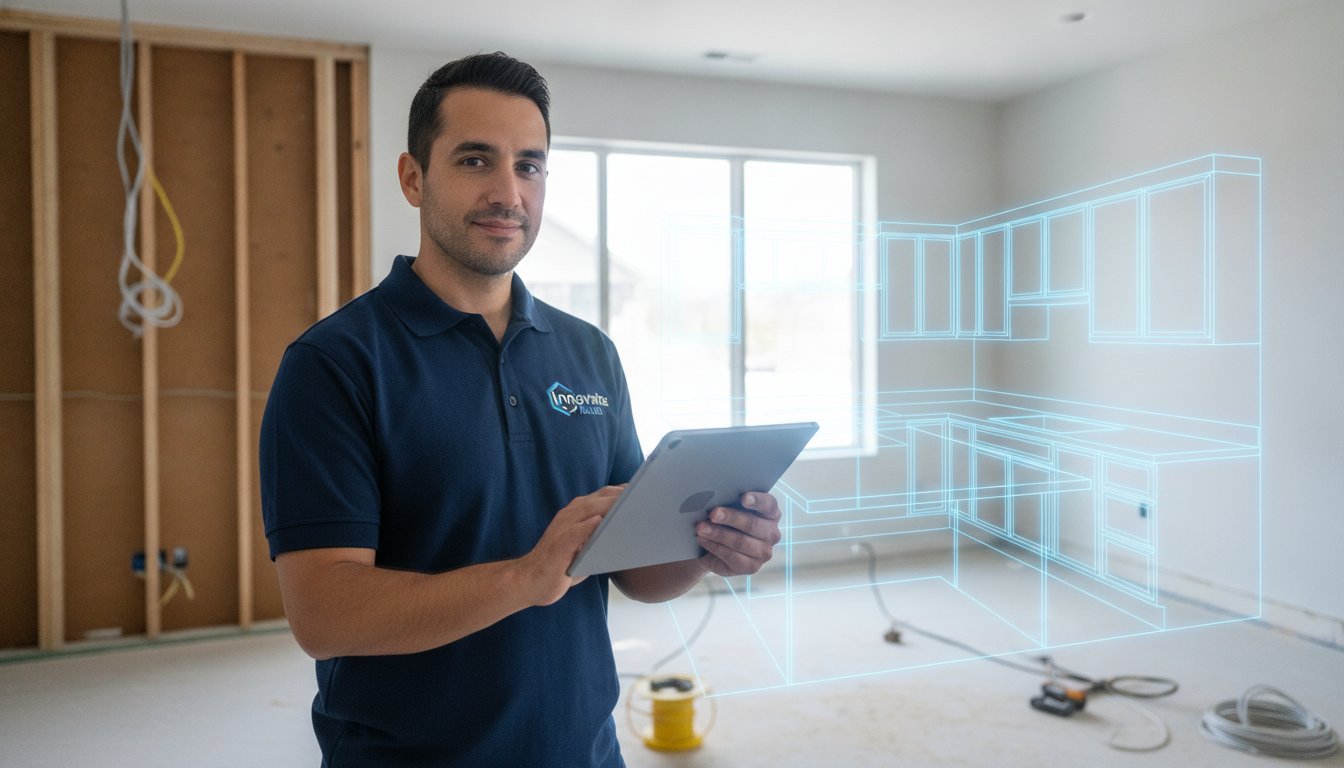
What if a single quarter-inch mistake cost you five thousand dollars? With cabinet tariffs hitting 50 percent in 2026, there's no room for "close enough" anymore. Improving kitchen measurement accuracy is now the difference between a profitable year and a major financial loss. You know the drill. You spend two hours on-site with a tape measure, only to find a wall is out of square when the cabinets arrive. It's frustrating, expensive, and completely avoidable.
Stop wasting time with manual sketches and slow turnarounds. This guide will help you master professional-grade measurement techniques and leverage LiDAR technology to eliminate manual errors. You'll learn to generate instant 3D visualizations and use tools like ArchKit Design to close bids faster while you're still in the room. We'll look at how to end the administrative fatigue of drafting back at the office. Move toward a zero-error workflow that keeps your projects on track and your clients impressed.
Key Takeaways
- Eliminate parallax errors and transcription mistakes that lead to expensive cabinet reorders and wasted labor hours.
- Leverage LiDAR technology for improving kitchen measurement accuracy, capturing every out-of-square wall with millimeter precision.
- Follow a professional site survey framework to map plumbing, gas, and HVAC lines before you leave the job site.
- Increase your closing rate by presenting instant 3D visualizations and firm estimates directly on your mobile device.
- Use ArchKit to bridge the "office gap," removing administrative fatigue by moving from scan to design in a single on-site workflow.
The High Cost of Inaccuracy in Kitchen Remodeling
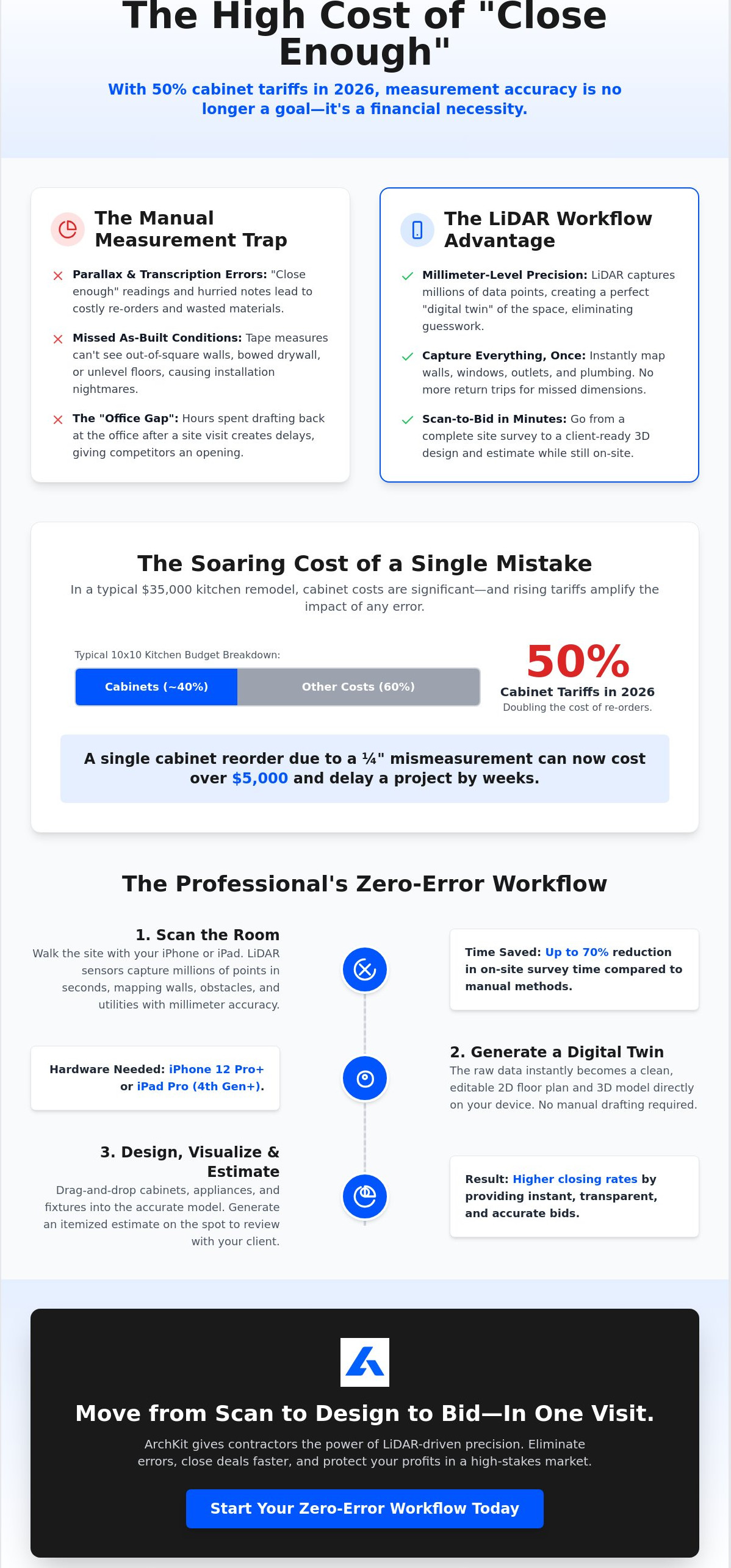
Precision is no longer a luxury in 2026. Since cabinet tariffs doubled to 50 percent on January 1, the cost of a mistake has skyrocketed. A mid-range 10x10 kitchen remodel now typically runs between $20,000 and $45,000. With cabinets accounting for nearly 40 percent of that budget, a single miscalculation can wipe out your profit. Improving kitchen measurement accuracy isn't just about good craftsmanship. It's about business survival in a high-stakes market, where companies like Direct Renovation Contractor Singapore prioritize cost-effective, high-precision results by working directly with homeowners to eliminate middleman costs.
Manual tape measures are the primary culprit. They rely on perfect line-of-sight and steady hands, things that are rare on a busy job site. Parallax errors occur when you view the tape from an angle, leading to "close enough" numbers that fail during installation. Transcription mistakes happen when you're rushing to write dimensions on a scrap of paper or a mobile note. These small lapses create a domino effect of delays and re-orders.
Human Error and the Manual Trap
Fatigue is a silent profit killer. Measuring 20 or 30 points in a cramped, poorly lit kitchen leads to mental lapses. You might read 34 and write 43. By the time you get back to the office to start your CAD work, the details are fuzzy. Measurement drift is the cumulative error that occurs when multiple small inaccuracies across a layout combine to create a significant total discrepancy. It's the reason why that final cabinet in the run suddenly doesn't fit the remaining space.
Reputation management is also on the line. When you have to tell a client that their project is delayed two weeks because of a measurement revision, trust evaporates. Professionals are moving toward digital-first workflows to stop these leaks. ArchKit Design allows you to capture data once and use it everywhere, eliminating the need for manual data entry. Improving kitchen measurement accuracy through these digital tools ensures your project starts on a solid foundation.
The Impact on Project Timelines
The "Office Gap" is the dead time between your site visit and the delivery of a bid. If you're still drafting layouts at home after a long day in the field, you're moving too slow. This delay gives competitors an opening to swoop in. Leveraging LiDAR technology allows you to close this gap by creating digital twins of the space in minutes. You eliminate the need for return trips to capture missed dimensions like window casing widths or soffit depths.
Leveraging LiDAR for 2026 Kitchen Measurements
LiDAR is no longer a futuristic concept; it's a field-ready standard. Light Detection and Ranging works by firing rapid laser pulses to calculate distances with extreme precision. While digital tape measures provide a single dimension, LiDAR captures the entire room volume. It creates a digital twin that reveals every bow in the drywall and dip in the floor. This shift is critical for improving kitchen measurement accuracy because it captures what the naked eye misses. With the 2026 update to ALTA/NSPS land survey standards officially accommodating LiDAR for data collection, the technology has reached professional maturity for your job site.
To use this technology, you likely already have the necessary hardware in your pocket. An iPhone 12 Pro or newer, or an iPad Pro (4th generation or newer), contains the specialized sensors required for high-resolution mapping. These devices allow you to establish a professional framework for accurate site surveys without lugging around tripods or heavy equipment. You get millimeter-level precision while moving through the space at a walking pace. It's fast, reliable, and built for the physical reality of a demanding remodel.
How LiDAR Mapping Works on the Job Site
Scanning a room is intuitive. You simply walk the perimeter while the app captures walls, floors, and ceilings in seconds. The sensors don't just see surfaces; they help identify obstacles like plumbing stacks and electrical points. This ensures your cabinet layout doesn't clash with existing infrastructure. For a deeper dive into the technical specs, check out the LiDAR Kitchen Scanner App Guide. This on-site capture eliminates the risk of missed dimensions that usually trigger a second site visit.
From Point Clouds to 2D Floor Plans
The software converts millions of raw data points, known as a point cloud, into a clean 2D floor plan. You don't have to spend hours at your desk translating hand-drawn sketches into CAD. The drafting process is automated directly on your mobile device. This is the most efficient way of improving kitchen measurement accuracy while slashing your administrative load. Industry data suggests that using LiDAR reduces survey time by up to 70 percent compared to traditional methods. You can literally finish the layout before you leave the client's driveway. If you're ready to stop drafting by hand and start winning more bids, you can get early access to the ArchKit Design platform today.
A Professional Framework for Accurate Site Surveys
Precision doesn't happen by accident. It requires a repeatable, field-tested workflow that removes human bias from the equation. The high cost of inaccuracy is often hidden in the hours spent on rework and the stress of mid-project "fixes" that eat your margin. By following a structured framework, you ensure that every data point captured is reliable. Improving kitchen measurement accuracy starts with how you prepare the physical space before you even open your mobile app.
Clear the workspace first. A cluttered room creates "shadows" in a LiDAR scan, leading to missing segments in your digital twin. Once the room is prepped, map your fixed points. These are the non-negotiables: sink drains, gas lines, and HVAC registers. In a 2026 remodel, moving these items can easily add thousands to a budget already strained by high cabinet costs. Capturing their exact center lines during the initial survey prevents layout clashes later.
Capture wall plumb and floor levelness digitally. Traditional levels are slow and prone to user error over long spans. Modern sensors allow you to see the "lean" of a wall in real-time. Finally, verify your dimensions against standard U.S. cabinet catalogs. If your scan shows a 35 and 3/4 inch opening for a 36-inch cabinet run, you've identified a critical fail point before the order is even placed. This proactive approach is the most effective way of improving kitchen measurement accuracy on every job.
Capturing the 'Invisible' Details
Small details cause the biggest headaches. You must measure for appliance clearance rules and swing paths. A refrigerator door that hits a kitchen island is a hallmark of a rushed survey. Account for window trim and baseboard thickness during your scan. These elements often protrude 3/4 of an inch or more, which can stop a cabinet run cold. Learn how to measure a kitchen for cabinet placement using digital tools to automate these tedious checks. ArchKit helps you identify these clearance issues while you're still on-site.
Verification and Double-Checking
Trust but verify. Use AR overlays to project your digital model directly onto the physical room. This visual gut check reveals immediate discrepancies that a spreadsheet never would. Spot-check critical dimensions with a laser measure to confirm the LiDAR data. This hybrid approach ensures total confidence in your bid. Always ensure your final layout complies with established Kitchen Layout Principles. Accuracy in numbers is useless if the design doesn't function. By combining high-tech scanning with a professional framework, you eliminate the "Office Gap" and move straight to a winning proposal.
Closing More Deals with High-Accuracy Bids
Accuracy is your strongest sales tool. When you walk into a kitchen, the client is usually nervous about the budget and the timeline. Improving kitchen measurement accuracy allows you to replace their anxiety with hard data. Forget the days of scribbling on a notepad and promising a quote "sometime next week." By leveraging on-site digital tools, you can present a high-fidelity 3D model before you even leave the job site. This is the "wow factor" that separates a pro from a hobbyist. It turns a vague conversation into a tangible project plan that the homeowner can understand immediately.
Confidence sells. A "ballpark" estimate signals a lack of preparation. A firm, data-backed bid signals authority. When you show a client their exact kitchen volume captured via LiDAR, they know your numbers are real. This transparency reduces the sales cycle significantly. You aren't just selling cabinets; you're selling a frictionless process. Most big-box retailers make customers wait for design appointments. You provide that value instantly. Using modern tech shows that you value the client's time. It signals that your business is modern, efficient, and less prone to the "contractor delays" that homeowners dread. You aren't just another guy with a tape measure. You're a technology-driven professional.
On-Site Estimating Workflows
Efficiency in the field means profit in the bank. By linking your accurate measurements to automated cabinet lists, you eliminate the middleman of manual calculation. This precision reduces material waste because you order exactly what the space requires. Check out ArchKit Pricing to see how professional estimating features can transform your bidding process. It's about moving from a survey to a bill of materials in minutes rather than days. A streamlined workflow includes:
- Automated cabinet lists based on exact wall dimensions.
- Real-time cost updates as you adjust the layout on-site.
- Reduced material waste through precise cabinetry layout tools.
Client Communication and Visualization
Expectation management is key to a successful remodel. Using 3D Kitchen Visualizers helps clients see the final result before the first demo day. This visual validation is the most effective way of improving kitchen measurement accuracy in the eyes of the homeowner. It reduces design revisions because they can approve the layout on the spot. You move from scan to signature in a single visit. Stop waiting for office-based drafting and start winning contracts while the lead is still hot.
If you're ready to outpace the competition and close more bids on the first visit, get early access to our professional workflow tools today.
ArchKit: The Professional’s Choice for Precision
ArchKit isn't just another design app. It's a specialized tool built specifically for the professionals who stand on dusty job sites. While general software tries to be everything to everyone, ArchKit focuses on a single, critical mission: improving kitchen measurement accuracy through a mobile-first workflow. It transforms your iPhone or iPad into a high-performance LiDAR scanner. You get millimeter precision without the need for bulky hardware or secondary site visits. This isn't about "getting close" anymore. It's about having total confidence in every dimension before you place a high-stakes cabinet order.
The platform features a comprehensive Standard U.S. Cabinet Catalog. You aren't just drawing abstract boxes; you're designing with real-world dimensions that match industry specifications. This ensures your cabinetry layout is physically possible within the captured space. Scan. Design. Estimate. You complete the entire process in a single on-site session. This "no-nonsense" approach removes the burden of administrative fatigue and lets you focus on what you do best: building exceptional kitchens.
Why ArchKit Outperforms Legacy Desktop Software
Mobility is your greatest competitive advantage. Traditional desktop CAD forces you to leave the job site, go home, and try to remember if an outlet was twelve or fourteen inches from the corner. ArchKit keeps you in the room. You design in the kitchen, seeing the layout in AR while you're still standing in the physical space. The speed is unmatched. You generate accurate floor plans instantly without manual drafting. Stop the office-dependent delays. Get Early Access to the ArchKit platform today and eliminate the "office gap" for good.
Streamlining Your 2026 Workflow
Modernize your business or get left behind. Integration with professional Cabinetry Layout Tools ensures your data flows seamlessly from the initial scan to the final order list. Future-proofing your business means adopting AR and LiDAR technology before it becomes a mandatory industry standard. Improving kitchen measurement accuracy is the foundation of a profitable remodeling company in a high-tariff environment. It's time to trade the pencil and paper for a digital tool built for the field. Try the ArchKit Kitchen Design App for iPhone today and experience the satisfaction of immediate, zero-error results.
Build Your Future on Professional Precision
The days of relying on manual sketches and "close enough" estimates are over. By adopting a digital-first workflow, you eliminate the risk of expensive cabinet reorders and the administrative fatigue of drafting back at the office. Improving kitchen measurement accuracy is about more than just numbers; it's about reclaiming your time and building a reputation for absolute reliability. You've seen how a structured framework and modern sensors can transform a chaotic site visit into a validated project plan in minutes.
Now is the time to lead the market. Utilize advanced LiDAR scanning technology to generate instant 2D and 3D floor plans. Access a comprehensive U.S. standard cabinet catalog to design with real-world dimensions while you're still standing in the kitchen. Don't let manual errors dictate your profit margins or your schedule. Take control of your workflow and impress your clients with immediate, high-fidelity results. Start your free trial of the ArchKit AR Kitchen Design App and experience the satisfaction of zero-error precision on every project. Your next successful build starts with the first scan.
Frequently Asked Questions
How accurate is LiDAR for professional kitchen measurements?
LiDAR technology delivers millimeter-level precision by capturing millions of data points across a room. It identifies subtle bows in drywall and out-of-square corners that a traditional tape measure often misses. Using this tech is the most reliable method for improving kitchen measurement accuracy in complex remodels. You capture the actual reality of the space. This ensures your cabinet layouts fit perfectly on the first try without expensive reorders.
Do I need a special device to use LiDAR kitchen scanning apps?
Yes, you require a mobile device equipped with a built-in LiDAR sensor. For Apple users, this includes the iPhone 12 Pro or newer and the iPad Pro 4th generation or newer. These sensors allow the hardware to map physical environments in 3D. Standard smartphone cameras without LiDAR rely on less accurate photogrammetry. That method doesn't meet the rigorous standards needed for professional cabinetry installation or precise site surveys.
Can LiDAR detect plumbing and electrical points behind walls?
No, LiDAR sensors only map what is visible to the laser. They cannot detect plumbing, gas lines, or electrical wiring hidden behind finished drywall. However, they are excellent at mapping the exact center points of existing fixtures like sink drains and appliance outlets. You should still use a stud finder or reference blueprints for a complete picture of the sub-surface infrastructure before you begin any demolition or drilling.
How does digital measuring reduce the time spent on kitchen bids?
Digital workflows eliminate the "Office Gap" by automating the drafting process. Instead of spending hours at a desk translating hand-drawn sketches into CAD, you generate a clean 2D floor plan instantly on your device. This allows you to provide firm estimates and 3D visualizations before you leave the driveway. Faster bids mean higher closing rates. You significantly reduce the administrative fatigue that usually follows a site visit.
Is ArchKit compatible with standard U.S. cabinet sizes?
ArchKit is built specifically for the North American market. It features a comprehensive U.S. standard cabinet catalog with real-world dimensions. This ensures your layout isn't just a pretty picture; it's a physically possible design. Using these localized specifications is a critical step in improving kitchen measurement accuracy. It accounts for the actual widths and depths used by major manufacturers, ensuring your design fits the captured room volume perfectly.
What happens if the kitchen is currently full of old cabinets?
LiDAR maps the surfaces it "sees" in real-time. If a kitchen is full of old cabinets, the scan captures the cabinet faces rather than the wall behind them. For the most accurate site survey, we recommend scanning after demolition or in areas where the wall is visible. If demo isn't an option, use the "Fixed Points" method to map the floor and ceiling footprints as a baseline for your new layout.
Can I export my measurements to other CAD software?
Yes, professional mobile tools allow you to move your data where you need it most. You can capture the initial scan in the field and then export the floor plan or 3D model to desktop software for advanced refinement. This flexibility ensures your on-site speed doesn't compromise your ability to use high-end rendering tools. It bridges the gap between the physical job site and your traditional office-based design software.
How much does professional kitchen design software cost in 2026?
The market has shifted toward flexible, subscription-based models for mobile tools. Many professionals prefer these apps because they offer lower entry costs compared to legacy desktop licenses that often cost thousands upfront. In 2026, you'll find options ranging from free versions for single projects to professional tiers for high-volume contractors. Check current provider websites for the latest pricing structures and early access opportunities to find a plan that fits your business needs.


